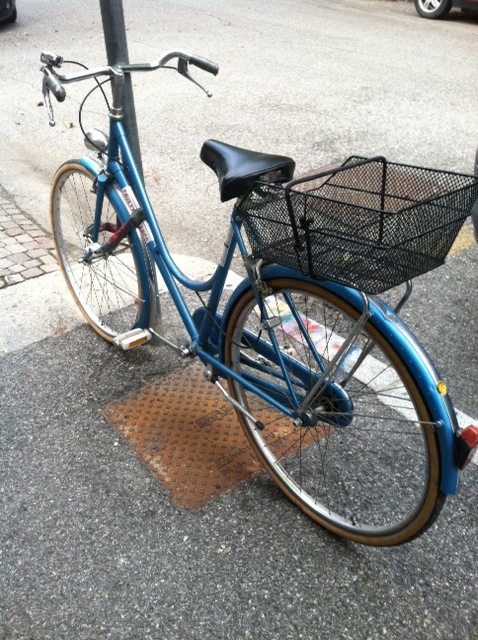
My infamous “city bike”
When, shortly after we arrived in Bologna, I uploaded few photos to my Facebook page, my friend Julia posted a comment about all the bicycles she saw in the picture. She thought it was a great sign about the city. So did I.
The first big writing project of my life had been a book titled Bicycle Citizens: The Political World of the Japanese Housewife. Cycling is both my sport and one of the most popular recreational activities in Italy, and Bologna is literally littered with bikes. I assumed from my first day here that my son, Tieran, and I would soon be whipping about town on commuter bikes and that, in my free time, I would be hitting the hills south of Bologna on a road bike that I was sure I would acquire used and cheaply from a local shop.
(Okay, so the free time thing is a total fantasy…)
But seriously. When I’m in Tokyo, I can always get my hands on a “chari,” a beat-up city bike. Usually a friend will loan me one from the family stash. But one year, when my son and I were planning to spend a semester in a Tokyo suburb, we got another friend to drive us to his favorite bike shop the day after we arrived. In a few minutes, I bought two used bikes in sound condition that I sold back to the shop owner at a slight discount four months later when we returned to the States. Bike shops and new and used bikes are readily available in Tokyo. Quick adjustments to brakes or seats are usually free of charge, and air for tires is also free at most gas stations.
Bologna is not Tokyo.
But seriously. We arrived here in the brutal heat of early August to find the city shuttered for the rest of the month. I really couldn’t imagine where, under the miles of grey aluminum that covered store windows, a bike shop might be. The Bolognese had gone to the sea for the holidays and left behind them a city of immigrants. We rode the buses together looking at each other in a wary, sweaty way and speaking every language under the sun but Italian.
Finally, one evening toward the end of the month, while seeking out Tieran’s school, I saw a small bike shop, just closing up for the day. A few days later, Tieran and I set out on our hunt for used “bici” (beat-up city bikes). My shoulders clenched to hold up my still weak Italian, I marched into the shop and announced to the man there that we were hunting two used city bikes and that, also, because I was a serious cyclist, a road bike. Okay, first I apologized for my bad Italian and then, while the poor man shook his head muttering his doubts about the likelihood that we would be successful in communicating, I plunged into my list of needs. But at any rate, I’m sure I kept my shoulders up about my ears somewhere for the whole conversation because I was trying pretty hard to get it right.
I got it right enough because he laughed (yep, at me) when I told him I was a cyclist and then he told me they had no used bikes, that I could buy one of their new city bikes for 150 euro and that I could rent a road bike for 20 euro per day, or maybe less if I talked to the owner but that I would have to come back Monday morning for that. Ahhh. Bike shop masculinity. We have it in America, too.
I was miffed at the laughter, and since on the streets of Bologna I had not yet seen a bike as new as the city bikes he offered me, I was unwilling to accept that new bikes were my only option. I headed out onto the Internet. I discovered an organization/bike shop that described itself as the source of the “social” bike (in English), which, in Italian, was explained as the commitment to recycle used bikes, to fight the black market in stolen bikes, and to put an affordable set of two wheels in the hands of every citizen. Okay. This was it.
I wrote a very polite Italian letter to the email address on the website, and I received a very polite reply suggesting I visit the shop personally where I might find used bikes and where new, red bikes would also be available for 80 euro each. The shop was in a suburb across town from us. We hopped a bus and made our way out there.
An older couple was embroiled in some sort of conflict with a lanky, bike-grease-gray man with a thinning ponytail and a girl’s green plastic headband to keep the hair off his forehead. After a bit of what seemed to be shouting, the woman marched out to the parking lot and returned with some object that she present to the grease-gray man. She scolded her husband. He bickered back and forth with bike-grease guy about dates, and then they left the bike for repairs and headed out. I hiked up my shoulders and prepared to make my case.
“We’re looking for used…”
“Used bikes? No, no, none here.” Bikeshop Gray gestured to the room full of old bikes, and I assumed they must be bikes left for repairs. “We have the new ones at 80 euro.”
“Just the new? We are only here for 10 months, and I was hoping to find used. Will you get…”
[As in Japanese, also in Italian one need never finish her sentence, although for different reasons.]
“At any rate a used bike would run you 50.”
“But 80 is more than 50. I don’t know, maybe I’ll have to think…”
Big shrug because, to a bike socialist what difference does 30 x 2 euro make, after all?
“Go ahead and think, okay, just you try…[he kept talking in an ever louder and more emphatic voice but I couldn’t understand it]”
I offered a quick thanks and headed out the door. The little red bikes were sitting on the pavement in front of the store. Tieran looked longingly at them. So did I. Pulled up my shoulders again and headed back in.
Bikeshop Gray was leaning over a bike another man (with a gentle, silent smile) was repairing.
“Signora.”
“I was wondering. If, when we have to return to America, we could sell them back to…”
“Sell them to me?! No, no, no, we don’t do that Signorna. Maybe in America you…[Bikeshop Gray leaned over the bike he was repairing and kept talking, seemingly unpleasantly but I couldn’t understand him.]
“Okay. Thank you.” Out the door we went again. I was shaking a little bit. It’s physically exhausting to keep one’s shoulders hunched when battling back the nerves caused by bike hunting in a foreign language.
We sat down on a little bench. I told Tieran the bikes were too expensive. Actually, they weren’t so much more than I had originally spent for the used bikes in Tokyo several years earlier. I mulled this over. We needed bikes. The buses were great to some locations, but Tieran’s school was not on a good bus line and at 2 kilometers, a bit far away for walking every morning.
I pulled up those tired shoulders one more time and tromped back into the store.
This time Bikeshop Gray was arguing with a customer who wanted to have the flat tire on his son’s bike patched. The valve was impossible. A new tire was imperative. No, it could not be done today, and not Monday either. Maybe Thursday. My Italian seemed to be improving by leaps and bounds. He sent the by-now-tentative father and son on their way.
“Signora.” This time with a note of exasperation even I could detect.
“I have thought [‘about it’ was really beyond my reach at that point]. We need bikes. We will buy the new red bikes.”
Bikeshop Gray chippered up and introduced himself as Jim (not his real name). He explained that I would have to come back on Tuesday because he didn’t have any ready at the moment. I didn’t have the wherewithal to ask about the ones sitting in front of the store. He gave me a card and wrote his phone number on it, and I gave him my name and number on a piece of paper. I told him that Tuesday didn’t work, that I’d be back Wednesday morning.
Wednesday morning I woke to a pounding rain. Before I was even out of bed the phone rang. Bikeshop Jim announced that the bikes were ready.
“Okay, good. But it’s raining this morning [and if I could, I’d tell you that I don’t want to cross the city on bikes in the rain with my 11-year-old son who cannot remember the last time he rode in traffic]. I’ll come on Thursday, tomorrow morning.”
“Thursday?!! Signora! Thursday there is a festa! [Party? Sometimes in efforts to clarify things for those who don’t speak our language well, we speak to them as if they are toddlers, thus making things even less clear for them.]
“But I can’t come today. I’ll come Thursday, tomorrow morning [What festa? A party on Thursday morning?]”
“Thursday?!! Signora!! Blah, blah, blah, blah.”
“It’s not good? Is tomorrow morning not good? When is good?”
“Tomorrow blah blah blah [louder this time].”
“Okay, then, I will see you tomorrow morning.”
“Signora!! Basta (enough) !!” [In class I hadn’t learned that “basta” was a way to end a phone call…]
Thursday morning, Tieran and I got up early and took the bus across town again. The bike shop was closed because, as the sign said, it is always closed on Thursday mornings. Ahhh- the “festa,” the day the shop is regularly “chiuso” (closed). Not a party. Closed. Damnit. Basta.
We got back on the bus and headed to Italian class. After Italian class, we joined a group from the school for a tour of a local church. On the way to the church, the phone rang.
Bikeshop Jim. “Signora.” With the low, growly tone of absolute, unmistakable irritation.
“Si?”
“Are you coming to the bike shop?”
“I went this morning. It was closed.”
“It is closed on Thursday morning but I’m here now. Are you coming now?” A definite bullying tone of rising anger. He could have been at the festa, after all.
“I can’t come now.”
Some shouting.
“Signore!”
He actually pauses.
“I know I’m not Italian and I don’t speak good Italian…”
Shouting.
“Listen!”
Shouting.
“Listen!”
A pause.
“I know I don’t speak good Italian, but I am trying. You have to have patience.”
“I am patient!! [more shouting] Basta!!” He hung up the phone in a complete and final demonstration of his patience. Goodbye Bikeshop Jim.
I did get bikes about a week later – two lovely clunkers from a friend’s apartment garden. Her father collects old bikes and repairs them. When she got home frome the seaside and realized I just wanted plain, old used city bikes she told me to come right over and get them but to buy a big lock on the way home. The theft of used bikes is the most common crime in Bologna. No wonder.
Then Sam, my boyfriend (companion, partner, friend, neighbor, whatever he is, but not his real name as he does not want a presence on FB or in the blogosphere) who is visiting needed a bike. Turns out that the first bike shop that doesn’t ever have used bikes suddenly had three used bikes for sale, including a smaller mountain bike we bought for Tieran so that Sam-not-his-real-name-friend-neighbor-boyfriend could use the bigger of the two older bikes.
Everything was then settled because at the apartment we also have a back “garden” (very large gravel patch rimmed by trees) at the building where my landlord told me we could put bikes.
Then the first afternoon I tried to park my bike in the back garden area, an older gentleman leaned out over his balcony on the far side of the building.
“Signora!!!Why are you parking your bike there?”
“My bike, uhh?”
His question was both hard to hear from such a distance and hard to answer, given that it seemed somehow to make sense only as a fundamental ontological question, demanding a level of Italian I just don’t have yet.
Luckily, in keeping with Japanese/Italian tradition, this man did me the favor of continuing on regardless of my incomplete response.
“Signora this is a garden. I have been tending it for twenty years. You may put some lovely flowers in the garden or a plant, but you may not park your bike there. This is not a parking lot.”
“Yes, it’s a lovely garden,” I agreed, hoping to smooth over the issues and looking about seeking something on which to focus my attention other than the gravel and an unused plastic table. Perhaps, in a Kyoto temple the gravel might be the base of a suiseki, water-and-stone, zen landscape but here it was just gravel. On the old man’s end of the space he had placed a handful of plants in pots.
“It is not lovely. It’s ugly because people are using it to park things.” He gestured toward another bicycle and a moto in a dark corner of gravel nearly as far from his window as could be possible.
“If you park your bike there, I will call the authorities. I will haul you in front of the courts.” It seemed a rather sudden escalation of the situation.
“I think you should introduce yourself before shouting at me like this.”
“Signora, you are the one shouting.”
Back and forth this went including my (in terms of language skill) triumph of a question “Who are you in relation to this garden? Are you the dean of the garden?”
Eventually, while he shouted, I wheeled the bike under his balcony, in the back door of the basement and into the dark hallway for the little storage units (the cantinas) for the apartments. Fumbling for a light switch, I dropped the heavy, old bike. I swore.
Then, suddenly, a light came on. A neighbor I had not yet met had come down to tell me to ignore the “pazzo” old man, that the “garden” could be used to park bici and moto, that she had been formally guaranteed by the condominium manager that she could park her moto there. She apologized that I should have been treated in such a manner by another building resident. I shook the neighbor’s hand and introduced myself. For the time being too sore about the neck and shoulders to go back out to the “garden,” I put the bike into the cantina.
Upstairs Tieran, who had apparently watched the whole scene from our balcony, was waiting for me at the apartment door. “That’s the best Italian you’ve spoken yet, Mommy,” he said with obvious pride.
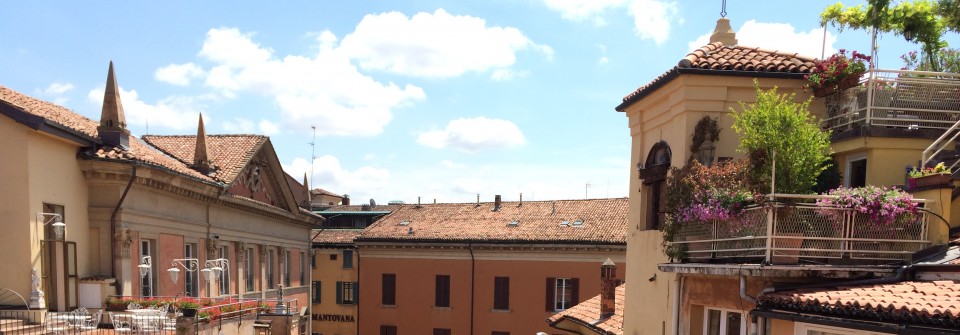
On afternoons and weekends, we ride our bikes down the cobblestone streets and across Piazza Maggiore (in the header photo). On weekday mornings, we get him to school more or less safely. We go to the parks and along gloomy medieval passageways and to the grocery stores. In my basket the water bottles and cheese and salami are not heavy. We slide along past the traffic, past the packed buses. I am a child again, full of joy with every turn of the pedals.
When we’re home, we store the bikes just inside the “garden” gate, at the side of the apartment building among some broken paving tiles beside a weed-covered fence. The old man would have to come downstairs and leave the building and come all the way around it to see how much they wreck the gravel landscaping. A few days later, a second moto appears, parked most evenings by the other in the back corner of the garden.
On Saturday morning, as I’m finishing my shower I hear a great commotion from the street below our apartment, angry sounds that seem to be made louder by the surrounding brick walls and then a big banging of the metal gate on the garden fence. When I’m dressed, I find my son at the living room window all excited. “It was the old man,” Tieran says. “He was shouting at a young guy with a moto! The young guy shouted back, a lot.” Tieran relishes the drama. I worry about what I’ve started.
Bicycle citizenship. So much I didn’t know.
 wonderfuladventuretrip
Molto bello il blog… però aspetto nuovi post, è da troppo tempo che non ci sono aggiornamenti. Vabbè, intanto mi sono iscritto ai feed RSS, continuo a seguirvi!
Grazie per il comment! Mi ha incoraggiato a finalmente finire un post che ho cominciato settimane fa!