For readers of “From Chari to Bici,” this is a second installment in the great drama of bikes at my building. For the sake of coherence, I repeat bits you might already know from the previous post at the beginning of this one.
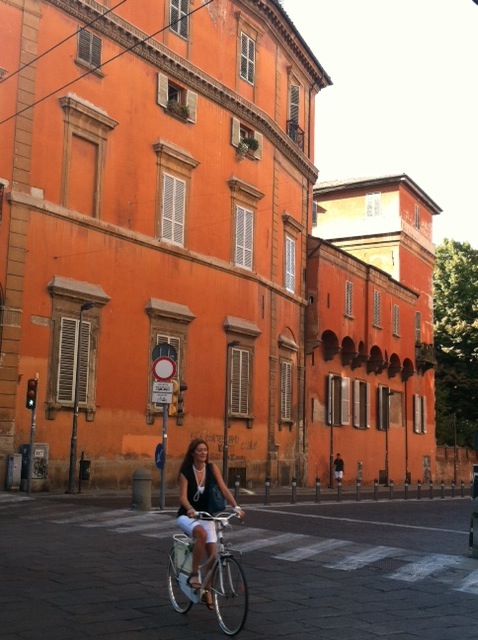
One thing I did not anticipate about studying community life in ageing Bologna is that I would become the focus of a multi-generational dispute among my neighbors! But in fact my bicycles (one for me, one for my son, one for my boyfriend) and I are the precipitating factor in a small but growing war in my palazzo (apartment building) between some of the elderly residents and the middle-aged residents and their children.
A male resident, whom I would guess is about 70, and his wife are enraged over the fact that we have been parking our bicycles in the so-called garden behind the apartment building. The man, who would not introduce himself even when I insisted upon it, tried yelling at me about the bicycles from his balcony one afternoon, demanding that I put them in the cantina in the basement, declaring I am destroying the “garden” (four large potted plants on one side of a large gravel yard that runs the length of the building) he has maintained for 20 years. He threatened me with claims that I will be hauled before the “justice system,” but my landlord and several other residents have insisted to me that I have every right to park my bikes there.
A week or so after he harangued me, the man’s wife accosted me on the street when I was locking the garden gate after parking my bike. She asked me who told me I could put my bikes back there. I told her that my landlord had assured me it was okay, and shaking her finger in my face, she began to yell “lies, lies!” Just as I was trying to tell her I was sorry she was so angry, another building resident walked up and told her to leave me alone. The wife marched off to her apartment in a huff. We still say good morning and good evening when we run into each other in the hallway, but the greetings have a certain chill in them.
From what I hear, the residents have had long and unpleasant experience with the anti-bike couple, but the agreed-upon strategy seems to be to simply ignore the angry husband and wife when at all possible. They are old and direct argument with them is probably of no use, residents tell me. I hear this analysis as both a desire to avoid conflicts and a genuine wish to be accommodating of the limits of the elderly. To protect this approach to the problem, several residents have stepped in to talk to the man on my behalf, and they have tried to suppress the expansion of the conflict by emphasizing to him my inaccessible foreignness, despite the fact that I have spoke with both husband and wife at length in Italian.
The college-student daughter of my neighbor from across the hall speaks English, and she tells me that maybe the guy has Alzhimer’s and assures me that I can call on her or others in her family for assistance if the man should cause me any trouble. Her mother says he is old and crazy and that I should just keep telling him and his wife that I don’t speak Italian. She says this to me in Italian just after expressing her surprise that I “understand everything she says.”
The woman in the apartment next door to mine has apologized for the fact that I must live in a palazzo with such a “pazzo.” My landlord describes the couple as “completely insane.” She reassures me that she has called to tell the couple that I have absolutely no Italian whatsoever, so there is no use in speaking to me. The couple does not pursue a further conversation with me.
Still, the tension builds. Three days ago there was an insistent ringing at my door buzzer. I was exhausted from a bad cold, and I was trying to take a nap. I was not awaiting any packages or guests, and I don’t really know anyone yet who might drop by unexpectedly. Most days the buzzing is from guys who have come to stuff the palazzo mailboxes full of pizza delivery fliers and are hoping I’ll let them in the building entrance so they can do that. I had ignored three buzzers earlier in the day. But I was getting the sense that this was not merely an obstructed advertiser.
Finally, I asked my son to answer the buzzer. “It’s a lady who is downstairs and wants you to come down,” he reported. Still hoping for a nap, I sent him to go see what she wanted. He came back. “She wants to switch mailboxes with you, and she wants me to give her your keys.”
Somewhat disbelieving and annoyed to be roused from the edge of what would have been a glorious stolen hour, I marched downstairs.
The woman, the next-door neighbor of the crazy, anti-bike guy, repeated everything she had told my son. She explained that many years ago she had hurt her shoulder, and she had been unable to reach the higher number 2 mailbox assigned to her apartment. Now her arm was better, and she wanted to move back to number 2. I should move to the lower box 12, the box she was using. Number 12 was the same as the number on my apartment, so the move made sense, she pointed out. There would be no problem at all in changing boxes, she insisted. “Give me your key and take down your name and move it,” she said, and then, almost as an afterthought she added, “What is your name? This is you, right?”
“What is your name?” I asked, “I’m Veltroni,” she said, giving me only a last name, not bothering to express pleasure at meeting me. I wondered if I would ever get to put into use the lessons on self introductions and polite meetings from the initial chapter of my Italian language textbook.
“I don’t understand,” I said. She looked at my son. “You understand me, don’t you,” she asked him. He nodded, eyes big.
“I understand what you said,” I restated, “but I don’t understand why I have to change with you.” “It’s a condominium regulation,” she said.
“I’m not the owner of the apartment,” I tried explaining. “Adriana, the owner, told me that my box was box 2,” I said. “Who’s Adriana?” the mailbox lady asked. Then she repeated that there was not a single problem in moving the boxes. The mailman would figure things out. For many years she hadn’t be able to use the box, but now it was time to change.
“How many years?” I asked. “Twenty years,” she replied. “Twenty years?” I asked, just to make sure I wasn’t missing something in the Italian. Twenty years.
I tried to ask her why she must change the box now, at 4:00 on a Tuesday afternoon. “Condominium regulations,” she replied. Somewhere in the middle of this she dropped some papers she was holding. “Could you get them for me?” she asked. “I can’t move my shoulder.”
My son and I, very confused, picked up the papers. I couldn’t think of any especially firm reason for not changing boxes, so I told the mailbox lady to go get her keys. Then I switched boxes with her. I put my name up on the new box in a bigger label, hoping the postman would quickly see that I was still there among the residents.
The next afternoon, the pazzo anti-bike man put a note up on the front door of the palazzo. In it he addressed a “stronzo” or “stronza,” (a vulgar word that can also describe excrement) whoever it might be, he said, who was responsible for putting dog poop in front of his “studino” (I think he means his little apartment). Then he went on to say, as if the issues were clearly connected, that the people parking vehicles such as bikes and motos (motor scooters) in his garden were acting in violation of the law. He had more than 100 photographs attesting to this illegal action, he claimed, a remarkable bit of extra work on his part, I thought, given the bicycles and motos were, at any rate, parked in full view of anyone in the city who might hope to see them. Sooner or later, he declared, the violators would come “before justice.” He concluded the letter with a section addressing those who “might wonder about my state of mind.” “My mind is completely tranquil,” he assured us. At the very end of the letter, he offered to provide photocopies of the letter at his expense to anyone who might request one.
A woman two floors down from my apartment walked through the door as I was staring at the letter. “Pazzo, completamente pazzo,” she said.
Yesterday, the college student told me her father is very angry about the problem with the pazzo. Apparently the anti-bike man goes on and on about his twenty long years in the building to her father, too. But the student’s father was born in this building. His mother has now moved to an apartment one building over, but he stayed here where he has been for the past 50 years. This is a good apartment building in a good location, she said. Her father doesn’t want these kinds of relationship problems in the palazzo.
I heard more yelling in the halls around noon, today. It went on for some time. Then I heard the front door of the palazzo slam shut. I looked out my living room window to see the college student’s brother striding down the sidewalk with firm, fast steps.
The yelling went on, now minus a male voice, and I couldn’t help myself. I suddenly remembered that I needed to check for mail and rewrite our name on the door buzzer marker in darker ink, anyway. I went downstairs and Mrs. Mailbox 2 was standing in the hallway talking with Mrs. Anti-bike. Mrs. Anti-bike was behind her cancello (a metal gate that locks in front of the apartment door but allows lots of light and air into the apartment). I couldn’t see her, but her voice was booming angrily. “Buon giorno,” I said to everyone and no one. Mrs. Mailbox 2 caught sight of me, nodded a bit shakily and pulled in behind her own cancello. I heard Mrs. Anti-bike ask her what the matter was, but I didn’t hear the reply. Mrs. Mailbox 2 said loudly, “I have lunch,” and then retreated behind her own cancello. When I came up the half a flight from the post boxes a minute or two later, both the doors and the gates from the two apartments were shut tight.
I figured the noise might have had something to do with the fact that last night a new note had been taped up below the first. Anti-bike man had written again, explaining that a “signora” of the building had asked him why he had described the palazzo garden as “his” garden. He explained that the garden had been his labor of love for many years and that it belonged to people with a passion for ornamental landscape (or a love at the least for four potted plants, I wanted to say). It did not belong to people who tried to use it as a parking lot for bikes and motos, he insisted. Again he offered to provide photocopies of his writing at his expense.
I read the note on my way out the door yesterday evening to accompany Tieran to basketball practice. I was still shaking my head over the note as we stepped out onto the sidewalk with our bikes. I looked up, and I saw an elderly lady I hadn’t met approaching me, smiling, making cooing sounds. But just as I was about to mount my bike for a quick getaway from yet another pazza, the woman pointed to a small orange and black cat, sitting inside the gate to the garden of the building next to mine (a garden with actual ornamental trees and landscaping in which all sorts of vehicles are parked). She asked me if I knew the poor cat, whose owner is dead.
I do know the cat. I see him every day. I remember the day I met him.
Several weeks back, a woman about my age, on her way home from dropping her child off at the elementary school across the street, had stopped me to ask if I knew anyone in my building who owned an orange and black cat that was living on the loose. He was in danger of being picked up, she said. I told her I had never seen one; I was speaking the truth. Then, a minute after she walked away, the orange and black cat jumped down from a ledge behind me and walked audaciously across my feet. He gave me a knowing smile; I was his new accomplice in crime. I have seen him a million times since then. I think of him as a friend.
His owner was the old lady who lived right here, the cooing woman explained, pointing to a window in the neighboring building that looked out toward my apartment. Then, she told me that the cat still hung about at the building and that she came by often to see him, to try to get him used to her, so she could take him in. She pointed to the busy road that intersected with my street. He’s in danger of being hit by a car, she said. I agreed.
“So you didn’t know the old lady?” she asked. “We just came in August,” I replied. “I don’t know anyone.” Or maybe, I thought, I already know too many.
“This is a good place, isn’t it,” the lady said gesturing up at my building. She said she lived a street over. “Not too much street noise here. A pretty area, with shops and schools. A beautiful little place to live.”
“Yes, you’re right.” I said. “I like it a lot.”
She wished me a cheerful good evening, and Tieran and I headed off to the gym, making our way through the busy evening traffic past the lights in the café windows, the men and women coming home from work or shopping, and the other children on their way to and from their sports.
After dropping Tieran off, I took a bike path to a side street where there is a vegetable vendor who speaks some English, corrects my Italian with the air of a friendly teacher, and knows all the words to all of the songs from Saturday Night Fever. “Buon sera! Good evening!” he said with a big smile for me as he took his place behind the counter. “I need onion,” I said in my bad Italian. And then “Is that one cipolle or one cipolla?” “Una cipolla,” he says, clearly. “And will you want to try some of our cheese? Our bufala mozzarella? It’s buonissma.” So I take some and with it some instruction about the importance of serving it at room temperature.
At a café just a block down, I stop for a glass of red wine to take up the remaining time before Tieran’s practice ends. “Full bodied or soft?” asks the proprietress, who moved here from Morocco as a child. I search for words. “I’ll pick it for you, and if you don’t like it, I’ll pour you a different one.” The wine is lovely. She points to her sister, the co-owner. “Remember,” she says, “I’ve introduced you to my sister. You can come back here in the mornings for breakfast when she’s here.”
“She doesn’t have to if she doesn’t want to,” her sister scolds her.
But, I think, I will. On a morning on which I can bear to miss my usual coffee stop, where they put in my order for a cafe macchiato before I can manage a “buon giorno.”
This is a beautiful little place to live. I like it a lot.
 wonderfuladventuretrip