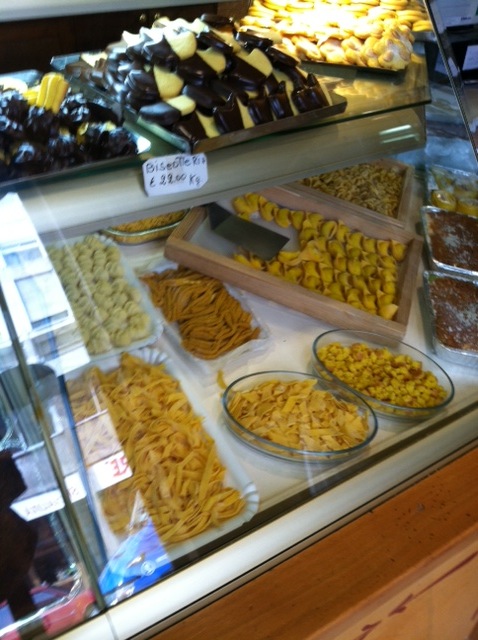
Pasta at a pasticceria nearby.
*In Italian the word used for grocery shopping is “spesa,” and it is employed with verb “fare” or “to do” in a way that translates to “doing the shopping.” “Spesa” also means “spending,” including government fiscal policy.
The butcher gets busy about 11 every morning. Women line up at his counter, and their orders aren’t simple. They’ve got to get them in because the store closes for the midday pausa at 1:00, and it doesn’t reopen on every afternoon.
I must look crazy intense as I watch the butcher slice thin turkey cutlets for me because he laughs.
“This way of preparing things is interesting to you?” he asks.
He looks like he must be Santa’s older, more serious brother. Short and round and silver-haired. Always smiling but without a beard.
“We don’t have this where I live in the United States,” I say. By which I mean not only the every-ready turkey breast and the way he makes it into beautiful pieces but also the counter, the shop: the stuffed rabbit ready for some grandmother’s oven, the endless sausage that his daughter just made in the back room, patties of spinach and veal ready for a frying pan, the fresh pork chops I know will turn out juicy, guinea fowls just a bit prehistoric, a huge piece of beef from which will be sliced thick Florentine-style steaks, the herbs on hand for seasoning meat to his customers’ needs, the homemade broth in plastic jugs, the salami from a farmer he knows, labeled simply “farmer’s salami,” three kinds of marinated artichokes, four kinds of pancetta, sheep’s milk cheeses from small makers, a stack of pieces of parmigiano reggiano the size of bricks, handmade tortellini, and real Bolognese ragu.
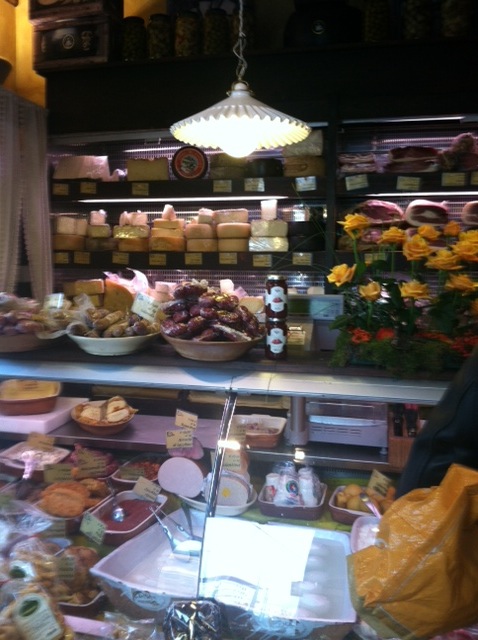
The counter at a neighborhood salumeria.
“This art is dead,” he says. “When I’m done here, this kind of shop will be done.” Finito. But I wonder because I see his daughter, not yet thirty, coming through with massive pieces of meat on her shoulders. I see them adding a few hours to their business week and a greater variety of the “support” goods – polenta, tomato sauce, dried mushrooms, risotto mixes – that will make the shop a more useful stop for customers without enough time for three or four stops at other places. And then, still, the ladies crowding around the glass are disconcertingly aged. The ones who know each other talk mostly about other friends’ ailments.
From my selfish perspective, the loss of the small shops of my neighborhood would be almost unbearable – and not because I love the goods sold in them (though I do!). In this city of insiders people seem shy, nice enough if you can find a way to start a conversation, but a bit awkward, a little bit withdrawn. It’s not just that I’m a true outsider with makeshift Italian and no history here. I see that on the streets people don’t smile at each other. Strangers don’t talk to other people’s dogs or flirt with other people’s babies. Old ladies chat up people in grocery store lines, but the objects of their addresses tend to look discomfited, as if random grocery store line sarcasm is the first sign of encroaching dementia. At my son’s basketball games a few parents are friends and gab on and on. Hardly anyone wastes time worrying about whether our team is winning or whether his or her child is performing well, which is nice but also means they don’t have a ready conversation starter. Lots of parents stand or sit quietly by themselves. I met one the other day because I worked up the courage to comment on the fact that she was reading the English Economist on her iPad. She seemed shocked at first, then more than happy to talk to me.
On many days, it is only as I trail from shop to shop that I get a chance for those little interactions that make me feel recognized, fully human. The man who runs the newsstand around the corner pulls my paper out as I walk in – follows the weather in America, knows how I voted in the last presidential election and was pumping his fist for our shared victory when I came by to get the paper the morning after. When wet, horrible slushy snow blanketed the city a week ago, he suggested, ironically, that Bologna was “just like Bormio,” the alpine town where he knew my son and I spent Christmas.
At the vegetable stand run by the Bangladeshi couple, I get (whether I want it or not) detailed advice on how to cook the vegetables I buy from the wife. Here’s one recipe that was great:
Put on water to boil for pasta. When the water comes to a boil add a few fistfuls of broccolini and cook them just a minute or two. Take them out, and then add the pasta to the same water. In a frying pan heat some oil with a bit of garlic and a little bit of sliced hot chili (half an inch of the finger-length, thin green one she stuck in my bag). When the garlic begins to get rosy, add the parboiled broccolini and “fry it a little bit.” Drain the pasta and add it to the pan with the broccolini, garlic, and pepperoncini.
“I always want you to get the best, I will tell you what is best,” she says.
At one of my two favorite cafes the owners always ask about my son. How is Italy going for him? The husband makes a cappuccino for me and one for a friend and puts a different design on the foamy top of each. “How have you been?” they ask. They want to know.
It’s not just me. Some mornings I have to wait to step into the little newsstand. Other customers are chatting with the owner. At another vegetable stand I frequent the owner and a customer are outraged about the treatment a friend got last week at the emergency room. The city is falling apart, they declare. I have to wait through their policy analysis to get my clementines. At my other café, I don’t expect to get a word in edgewise. Gianni got a new car. Somebody has stopped by to drop a bag or set of keys that another friend will pickup later. Three customers and the woman who runs the coffee machine are trying to solve a word puzzle on a radio show being played in the background.
And shame on me. Saturday night trying to buy a dress on sale in a fancy shop in the historic center, I got tired of waiting for the cashier to catch up with a friend who had jumped in front of me just as it was finally my turn in line. “I don’t need it after all,” I called out a few minutes into their joyful chatting. Of course, the saleswoman apologized profusely and immediately rang up my purchase, a meager sort of thing that kind of shop would not have considered a real sale before the crisis. “The customer always comes first,” she said. “I should not have been talking to my friend.” “No, no,” I said. “I’m just tired. Your friend is important.” But I could tell the saleswoman didn’t believe me when I tried to retract my earlier impatience. She didn’t believe me, but she needed my little bit of business. Desperately, maybe.
I worry about the butcher. I’m probably his greatest admirer. But pressed, pressed by my sense of the need always to keep up (with a research agenda modeled after that of my Princeton colleagues, with an over-scheduled 11-year-old for whom I have all those upper-middleclass ambitions, with my relentless American sense of time and my midlife fitness regimen) I need things faster most days. I don’t want to wait through the complicated orders and stories of the customers ahead of me. It would be easier to go to the supermarket, which doesn’t take a lunch break. More efficient. More productive. Cheaper.
 wonderfuladventuretrip