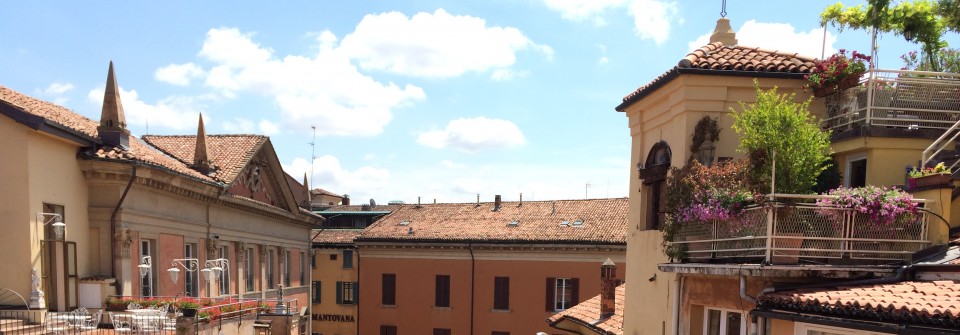
Dearest reader, we are sorry we have abandoned you. But it has been raining in Bologna.
Since November.
First with off and on drizzles and occasional horrible downpours that gave promise of clearing soon. Then in steady, hard-working unfancy wetness. Followed by weeks of wintry mix (the name of a dessert that isn’t) sticking up sidewalks, making black-brown slushees of the stuff kicked up by accelerating buses. Then arriving in driving, icy needles piercing our shiny, puffy overcoat, freezing on our umbrella. At last coming down as sheer misery among the dog poops that no wet owners would pick up. It has been raining and cold and sometimes snowing and at best offering grey, low, damp, ultraheavy clouds under which one might scurry to the shopping between rains, dancing around the dog poops, spreading always from the rain that has just fallen on them.
Since November.
We have tried our best. We have drunk hot chocolates more like stews served with full cups of whipped cream (panna montata, unabashed mountains of cream, we can’t help thinking). We have tried lunches of tagliatelle al ragu or octopus-potato salad at the top floor of Eataly, under the drenched, modern skylights that brilliantly accent the medieval setting outside. We have sipped our broth and savored our prosciutto-filled tortellini.
We have hiked up the world’s longest portico from the Saragozza gate at the southeast of Bologna’s historic center to the shrine of the icon of Madonna of San Luca. She performed the miracle of stopping the torrential rains of 1433, but she has been on vacation ever since. The four-kilometer portico connecting 15 chapels by 666 arches up a very steep hillside was built in the early 1700s to allow the faithful to bring her down dry to the main church on the center piazza in her annual procession, despite the expected and ancient soaking weather.
Absent divine meteorological intervention, we graduated to ridiculous lunches at an enoteca with a carta di vini longer than War and Peace and Irish coffees at sunset (at 4:45) at the very elegant café Zanarini.
A careful attention to the qualities of a mid-priced Barbera followed by somber examination of a trio of purple-blue cheeses against a glass of vin santo does help to discipline the dragging edges of one’s mood. Alas, few have livers built for drinking their way out of a Bolognese winter.
Finally, really we have simply given in. We have sobbed our way around the dog mess en route to spin class in a gym overcrowded with middle-aged women bitching about the endless winter. We have moaned over the colander of draining pasta and dripped into the afternoon teas that have not been sustaining. And we have used a lot of bleach to beat back the mold that simply won’t be put off in a city that is wet, wet, wet, but not, really, all that cold.
But we have not been writing, because, dearest reader, we are more like the Wicked Witch of the West than we would like to admit. And damnit, in enough water, we melt.
So, I’m sorry. I have had things I should have wanted to say. But, look, even the Pope walked out. The whole, entire nation has been soggy in soul and body. A week before the recent parliamentary elections, a taxi driver taking me (yes, in the rain) to a speaking engagement told me he hoped the whole lot of incumbents would be sent home. “A real rottamazione?” I asked, using the word that a 37-year-old young upstart in the center-left Democratic Party, mayor of Florence, popularized a little over a year ago in a call for national-level leadership change. Rottamazione: a term which, according to Lo Zingarelli, the standard of Italian dictionaries, was previously used mostly for describing the process of junking old cars to recycle their useful bits. “Yes, a rottamazione,” said the taxi driver. “We couldn’t end up with anyone worse than we have now.”
His sentiments were echoed by seemingly everyone I met. The slow-building rage at the weather that infected political scientists and café owners alike was topped only by the widespread agreement that all of the politicians who held office deserved to be sent “a casa” (back home). “They rob us, they rob us, they rob us, and then they want more taxes, but we don’t have any money,” was one—or in a certain sense—every response I would get to my stupid but unfailingly provocative, “I don’t understand what’s going on in Italian politics today.”
The anger was interesting to me. Of course, it should have been, given that the analysis of grass-roots political consciousness is literally my entire career and, at base, the sole reason I am living here in Italy. But eventually the rain dampened even my lifelong curiosity to such an extent that, by Tuesday night, all I could think was, “I’m done. I’m done with Italy. I want to go home.” Actually I keened this, rocking slowly back and forth in a kitchen where I couldn’t think of a single thing I wanted to eat for dinner. If I were not the mother of a perpetually hungry 11-year-old boy, I would have crawled in bed, downloaded a Grisham novel to my Kindle and stayed there for the foreseeable future. Downton Abbey was unfortunately not an option; I used that to get through February.
Intellectually, I know there must have been days like this in the first year or two of my relationship with Japan. I remember moments. I remember sitting, on a July afternoon, in a campaign office set up on the fourth floor of a building in central Tokyo that was scheduled for demolition as soon as the elections concluded and we moved out. There was no air-conditioning, so the office managers had resorted to a climatization trick of a different era.
They had an ice manufacturer bring in a giant block of ice. Behind the ice they placed a fan that blew the hot air over the ice, melting it, spewing moist, cooler air into the room beyond. My pale ultra-wasp face must have been red with the heat because the campaign workers with whom I had been addressing envelopes moved me to a seat directly in front of the ice. The aging women in the office waxed nostalgic about the early postwar days in which a fan and a block of ice had seemed a luxury.
To me the increased humidity caused by the melting ice obliterated the comfort of the cooler air. Not the least bit grateful for my prime seat, I gave up on work and headed at a determined pace to a large public pool to swim laps. But the pool was so crowded I couldn’t manage the laps. First, I had to keep stopping to tread water in order to avoid running into the person in front of me. When I changed to a faster lane, I was clobbered from behind by a man considerably abler than I. On a turn at the end of the pool, the life guard stopped me and tried to explain what the lane rules were. In tears, I simply got out of the pool and ran to the locker room where I sat on the floor huddled in a corner sobbing loudly until I decided that I would rather dry myself off and head home to my sweaty 10 x 6 apartment than be gently carried away to an asylum by concerned fellow swimmers. These days, it feels like it would have been so much easier to return to Japan for my sabbatical than to start all over in a new country, but back then Japan must have been hard, too.
Yes, I see the theme. I am a weather wimp. I admit this freely. I have always wanted to live in San Francisco where the temperature would always be right, where sun might carry me through midday and fog lull me to sleep at night. Yeah. Well. I should have picked a different career. But to be fair, I did betray Japan for Italy, and I did it fully convinced that the lovely weather I had seen in Rome so many times would be a pleasure. This year, even in Rome, the city Italians declare has a famously beautiful climate, it has been raining an extraordinary amount. Did I mention that the Pope quit his job?
To sum up, by early last week, I had reached a state of weather-induced neurosis such that my thoughts revolved incessantly around the worry that my research has stalled out (I am trying to branch out to a new segment of society, the precariat young people, and I’m finding it hard to pin them down for interviews, maybe because their lives are precariously organized), the sense of being at times intensely lonely (I have only a few friends, and they are, like middle-aged people everywhere, busy with work and children and…), and, and well, my rage against dog owners who will not remove their pets’ deposits from my walkway. The tortuous construction of the previous sentence does not begin to reflect the tortuous circles of my mind.
Just a brief digression: in early December I interviewed a local official who is also a noted urban planning scholar and architect. She is graceful, accomplished–intimidating, frankly. But partway through the interview, as she was describing the city’s approach to managing populations of disaffected youth who live in the streets or occupy abandoned factories, she paused to insist with what I naively thought of as uncharacteristic abandon that, if young people taking drugs in a piazza near the university are a public nuisance, equally are the bourgeois ladies of the more upscale neighborhoods who do not clean up the “cacca” of their pooches. At the time, only a week or two into the rains, I thought the urban planner was exaggerating the comparison for the sake of some sort of political correctness toward young people. Now, I know better.
Back to my story. On Thursday, the sun came out, not for an hour or two but for a whole, warm day. We woke to a shocking blue sky. After I took Tieran to school, I dragged my road bike from the basement and headed for the hills. Everyone was out. At each of the five roundabouts I have to pass to get out of town, there were more cyclists than motor vehicles! The terrain rose up around me greener than I could imagine. Pools of water still swamped the low-lying fields but sprouts of something promising poked their way up through the puddles. The tree below the apartment balcony burst into bloom. I discovered that the park near our house is rimmed in forsythia, not wet sticks, after all.
On Friday morning there was sun again. Italy had formed, tentatively, a sort of government out of the mishmash of parties that came out of the angry election (the low turnout for which has been blamed partly on the rain and snow that fell across the country that day). My son, who had been absolutely distrustful of the break in the rain on Thursday, came home from school Friday wreathed in smiles. He suggested a walk. We zigzagged through our neighborhood, noting all the heavy buds on the deciduous magnolias, the trees that always break my heart by showing their stuff too early in the more variable springs of Virginia and getting burnt into brown in the frost. Here they will bloom safely.
We pointed out to each other our favorite buildings, examples of late 19th century architecture, of early 20th century modernism, the charming bits of fresco below the roofs, the rounded balconies and 1930s porch rails. We each chose the villas we would buy if only. I made him promise to get me an apartment with a terrace garden just outside the city walls when he grows up and gets rich.
We ended our walk at the little park just a half block from our apartment, in front of the gelateria-bar where at 11 p.m. on our first night here in August, I had breathlessly procured water, Coke, beer, in that first ritual of settlement. The establishment is really no more than a biggish cart with an adjacent terrace shaded by a vinyl tent. It closed in October and had sat abandoned for months under slowly spreading mildew.
But on Friday afternoon, we saw the mildew had been scrubbed away. The curtains of the tent had been pulled back, and the chairs and tables, stacked away last fall were now spread out. A line of mothers, grandmothers, and children jabbered at the service window. “When did you open,” they all asked the owner. “Today!” she chanted as she doled out scoops of pistachio, strawberry, chocolate chip, cream, and hazelnut. The grownups were definitively more thrilled even than the children who bounced and whooped through the park. And at home, in front of the apartment, some mysterious future saint had removed the massive pile of dog mess that had been there for days, fueling my grim winter mood as surely as yak dung heats a Tibetan tent (this according to a friend who knows).
Yesterday morning, Saturday, also dawned with sun. But by now I was beginning to wish for others with whom we might share it, some adult with whom to have a glass of wine or beer and a long, Saturday conversation. I felt my alienness, knew the truth of the limits of trying “live” in a foreign town for a mere 10 months, not really time enough to establish one’s own social space, too long to get by simply on calls home and the novelty of a new culture.
Tieran and I headed into the historic center on foot. We still had a little bit of the joy of re-seeing the city again. But I could also now feel that the strain of being here was more than a problem of weather. Then, the phone rang. It was another single mom, Bolognese woman my age with a child Tieran’s age I had met months ago. She apologized. They had been so busy, and she never managed to call us even though they really hoped to see us. By any chance would we be free for lunch? Of course, we were!
On the way to her house, I bought a really decent local cabernet for less than six euro on the recommendation of a wine dealer who has never done me wrong, not for six, nor for 30. We got a collection of pastries at a lovely shop in heart of the center.
We ate a simple pasta, and the other mother and I talked for hours: men, politics, the church, the possibilities of reincarnation, the impossibility of ridding a Bolognese home of mold. My son and hers played soccer in a nearby churchyard. A bit before we started home, the rain started up again. The fresh-washed clothes I had hopefully hung on the line off the balcony were doubtless already soaked. The weather looked to have moved in for sometime to come. “I am going back to bed until next Friday,” was the text message an American friend here sent me. She means it, I thought.
And yet.
We wandered under the beautiful Bologna-orange porticoes to a stop for our bus. One was late, and so two came at once. We jumped on the second and had, as we almost never do, two seats.
At home, I hung the soggy laundry over the radiators and put some chicory on to boil for supper. I would serve it with spaghetti alla carbonara. I already had eggs and pancetta, and I had no intention of shopping in the rain. Then, I opened a book that the American friend, taken to bed in a protest against rain, had bought me a week ago when she was still willing to venture out. Elogio dell’invecchiamento: alla scoperto dei dieci migliori vini italiani (e di tutti i trucchi dei veri sommelier) (An Elegy for Aging: Discovering the 10 Best Wines of Italy (and all the tricks of real sommeliers)) by Andrea Scanzi.
At the beginning of the chapter on the wines of the Piedmont region, Scanzi suggests that the reader, while working her way through the next section, drink a famous Dolcetto and listen to Keith Jarrett’s jazz. I didn’t have the famous wine recommended by Scanzi, but I poured myself a glass of what the reliable wine dealer had told me was a decent Dolcetto at a shockingly low price. And I set my iTunes to Jarrett’s Solo Concerts, Bremen.
My cheap version of the wine was good enough but not all of the things that, according to Scanzi, it might be. Still, I understood perfectly what he was saying about Jarrett, and about the mountains in which one of his particularly favorite vintners might be found, about playing, repeatedly, with the same note (or finicky grape), with something hard that doesn’t yield its secrets easily, that takes time, that is demanding, frustrating, risky, inevitably vulnerable to bad weather, impossible to describe. And sometimes, also, worth the trouble.
Yes, dear reader, it is still raining.
 wonderfuladventuretrip