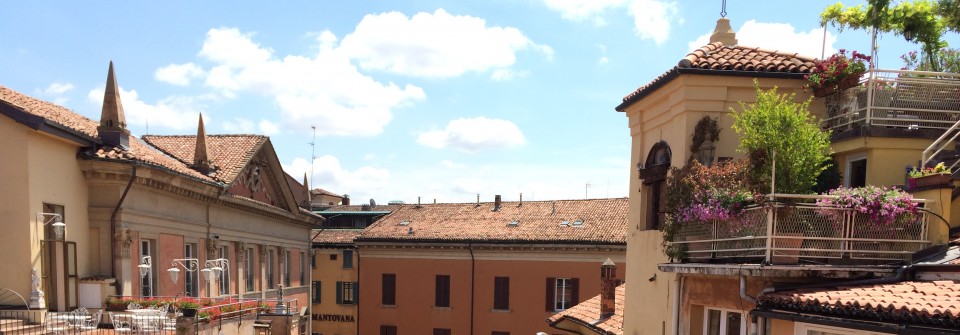
with debts to the song, “Weather with You,” from the 1991 album Woodface by Crowded House
Note: With apologies to cheese and wine lovers, I must admit this is more about motherhood than Italy (or Germany – you’ll see).
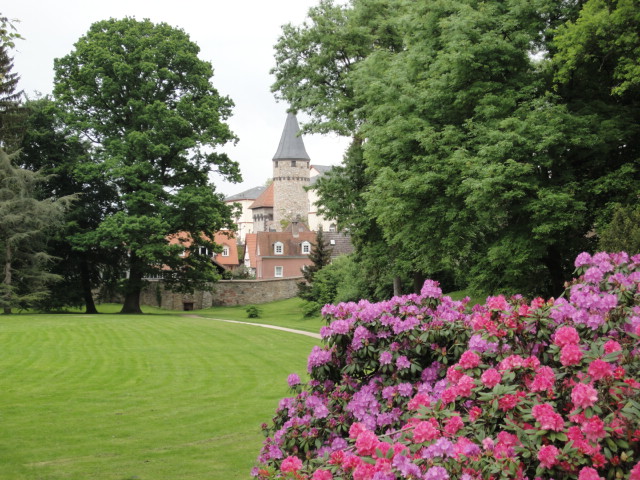
Spring in Bad Homburg, Germany.
My mother was crazy. Actually crazy. The night my brother and I called our baby sister to tell her that mom had finally gone completely around the bend and would have to be committed, the first thing out of my sister’s mouth was “Oh, thank God. Now we know we weren’t just imagining it.”
Maybe that’s the hardest thing for children of mentally ill parents, sorting out the parts of their childhood that bore some relationship to “reality out there” from those that were created to the ease the mind of their suffering parent. I know even today, two decades after we all admitted my mother had a very real illness, and seven years after her death, I will suddenly find myself stalled in the middle of something I’m trying to do, wondering desperately if I’m just repeating the rituals taught me by someone in the grips of insanity or applying the good sense and sound morals of a wise woman.
It’s not always easy to tell the difference. Sure, when she insisted that the mafia had rigged the graduate student Fulbright competition in my favor in order to turn me against her as part of their plot to move drugs through the importation of Japanese azalea cultivars, I had a general sense that she was off. But at other times, it was infinitely more difficult. My mother was crazy, but she was also a power onto herself and often a sage of sorts. She had views on the world, and good student that I have always been, I learned those views. As my son, Tieran, reaches adolescence, I find that I have a much bigger store of my mother’s views than I had thought.
My mother, who, as she never tired of saying, was from “an Old Southern Family,” put a great deal of energy into turning me out according to the standards of what she called “good taste.” As an adult, I’ve learned both to recognize this “good taste” as part and parcel of the White Anglo-Saxon Protestant ethnic identity project and to mobilize when the occasion—a job interview, my university’s parents’ weekend reception, a conference presentation—calls for WASP drag.
True to the requisites of the WASP good girl standard, my mother refused to allow me to perm or color my hair in middle school and high school. So, throughout most of the big-haired, multi-colored 80s, I had long, sleek hair that I’m sure looked cute, reassuringly innocent. (Though I tried, desperately, by sleeping with my hair in braids, to add a little something on my own.)
My father, who was not crazy but an engineer from a working class background, had a plan for everything and worked hard to help us all maintain the fiction that my mother was anchored to the same world in which the rest of us lived. He completed my adolescent look by insisting that I wear jeans two sizes too big—in the same era in which nothing came between Brooke Shields and her Calvins. He explained to me that his stepsister had attracted the wrong kind of boys by wearing the wrong kind of jeans. My parents were not stupid. I left high school with my virtue intact and a lingering sense of guilt that surges up every time I color my hair or wear something that veers too far from my solidly J. Crew style center.
So, when Tieran, who was born with exactly the sort of face you expect to see on the front a prep school view book, came to me last week with a photo of a radical new hairstyle he wanted, I was momentarily destabilized. At 12, I had one training bra, some cherry-scented lip gloss, and a modified Dorothy Hamill haircut that didn’t work because I have fine, straight hair, and I was not allowed curlers or hairspray. He wanted the hair on the sides of his head cropped tight while the top would be left long and then swept up and off his face in a kind of tower of hair that could obviously only be produced with a carefully managed blow dryer and some serious product.
I tried to tell him that it was not the sort of cut that “people with hair like ours get,” but I think, frankly, I didn’t put much feeling behind my words. The pictures got me thinking about these two German kids who were at our school for a year in the 80s, with big, blonde mohawks that defied every kind of weather. Our town, Oak Ridge, a sort of Tennessee nuclear weapons sister of Los Alamos, was brainy and aggressively middle class (because nearly every family had a government salary). We were outstanding on the SATs, not in fashion. Their hair made those German brothers important. Rumors went around that they used egg whites to keep their hair on end. The idea that they were this hardcore in the pursuit of New Wave style only made them seem cooler. I wasn’t really cool enough to talk to them myself, but I still remember watching them get on the bus on rainy mornings, hair joyously raised against the storm.
As I was talking to Tieran, I was thinking about those kids and about all they represented for me of the worlds beyond the mountains of Tennessee. I was thinking, if we couldn’t find the right product to keep his straight hair aloft, we could always try egg whites. I said again that I thought that “people with hair like ours” don’t do hairstyles like that, but I could hear that what I was really saying was that people with WASP faces like ours are not traitors to our kind. It wasn’t a message I could push very hard.
In Italy, men do themselves up. At first, I was uneasy with this. I am most familiar with the aesthetics of the American South, American universities, and middle-aged Japanese men. I can say truly that I have always celebrated alternatives to the polo or oxford shirts and conservative haircuts that dominate in these crowds, but, with the exception of some Japanese youth who take their style from the world of manga and anime, most of what I have seen as “alternative” has fit in a predictable range of black turtlenecks, trusty old leather jackets, sneakers with slacks, and t-shirts with ironic labels or made out expensive performance fabric.
Here men have all kinds of haircuts, and those styles often shine with the gel that keeps them in place. Grandfathers pushing babies in strollers wear orange suede shoes. College students wrap themselves in beautiful, patterned scarves that are way beyond the pale yellow to light blue spectrum allowed American men. Guys in leather jackets walk pugs in matching leather jackets, and doing so is not a statement of their sexuality. Men’s glasses come in every color. Many of them carry bags that remind me of purses.
Don’t get me started on style among Italian cyclists. No, I seriously can not get started. I can’t afford it! The American Wall Street Journal recently declared that, after the dethroning of Lance Armstrong, slick cycling gear has gone out of style. Let me just say that Italy is not America and the Wall Street Journal, well, it’s not fashion.
Last week I saw a little boy, maybe eight, pop out of a parent’s car in front of the elementary school. His super fine light hair was gelled up into a crest. He had a “varsity” jacket on of the sort that is all the rage here, and he swaggered down the sidewalk with obvious confidence. He was beautiful.
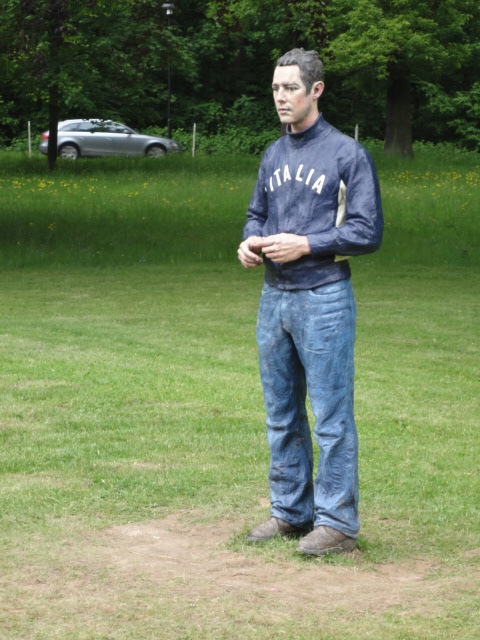
Italian man as art in the Kurpark, Bad Homburg.
I told Tieran that my only rule was that he find a way keep the hair out of his eyes. We went down the street to the barber we have used for Tieran’s other cuts here. To me the barber seemed precise. The other cuts had been flawless, if not especially distinctive, and I figured he would be up to the task of recreating a magazine photo on my son’s head. Plus he is a nice guy. He had tried to draw Tieran out on other visits, tried to ask him about his preferences. But Tieran is shy, and so he had said little. When the barber asked him if he liked the previous cut, Tieran had offered only barely perceptible nods.
This time, when Tieran handed him a photo of a guy with hair he was looking for, the barber reeled in shock. “Signora, have you seen this,” he asked me. “Is this okay?”
I assured him that it was fine if it was what Tieran wanted, and the barber went to work. It didn’t take long. A little work with the blow dryer and a round brush, a spray or two of something to hold it all, and Tieran had the cut in the picture. An elderly man, mostly bald, who was waiting to have his hair cut after Tieran got up to take a look. “I want it, too,” he said, laughing and running his hand over his bald spot where Tieran’s upswept crown of hair would have been. “It’s troppo bello (too beautiful).” The barber agreed. I agreed. The radical cut unexpectedly suited Tieran’s even features.
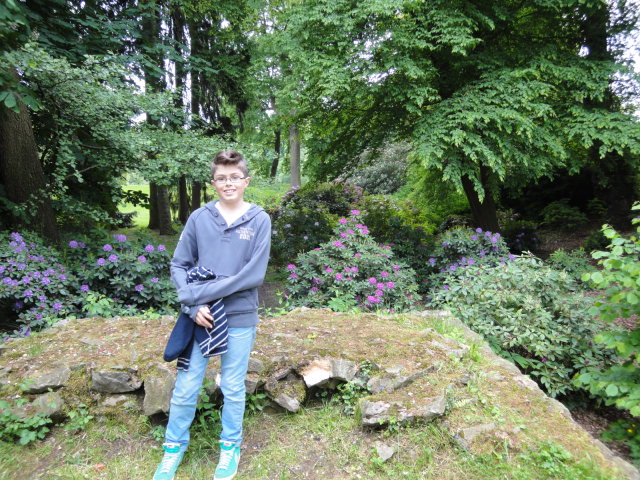
Tieran, with new hair cut, in the Bad Homburg palace gardens.
We went out to dinner with a friend. Secretly, I wondered if I hadn’t been a little too rash in rejecting my mother’s standards for children-from-parents-of-good-taste. Might it be possible that in supporting hair adventures like this, I was leading Tieran astray, encouraging some sort of lethal vanity or soon-to-be-chronic bad attitude about whatever it is that good girls and boys know to respect? Might he grow up wrong somehow because I still had issues about the crazy mom and the jeans my dad picked out?
Yet, dinner was fine. Some people paused to give Tieran an extra glance, but I think that was more because the style worked than because it was so unusual. In fact, once I had gotten used to Tieran’s new look, I started seeing funky hair cuts everywhere.
The next morning, in cold, pouring rain we left for Frankfurt, Germany where I was scheduled to attend a three-day conference in Bad Homburg, a spa town in the Frankfurt suburbs. Even in the rain, Tieran’s hair held up, and the generally conservatively dressed academics at the conference (run by German social scientists specializing in Japan) were outright complementary about his looks. Like the elderly gentleman in the Bologna barbershop, a balding Austrian with a long ponytail proclaimed his outright envy. Quiet Tieran stood confidently in the glow of his style success. (Take that, Mom, I thought.)
The conference weekend turned out to be the strangest sort of encounter with my mother. The weather, true to all we have experienced this year, was horrible. The temperature struggled to get out of the 40s. A few brief threats from the sun did not succeed in scaring off the wintry rain that fell all of our first day there, dampened part of each of the next two, and delayed our departure at noon on Sunday.
We had taken a cheap six a.m. flight into Frankfurt, and so, even after two trains from the far side of the city to this northern suburb of Bad Homburg, we arrived at the hotel in time for breakfast.
The buffet was sumptuous. There were two yogurts, three kinds of muesli, stacks of different types of bread, four different preserves, eggs, sausages, something very much like bacon, cheese, cold cuts, and, almost unbelievably, my mother’s coleslaw, and pickled green beans and sweet peppers. I am not kidding. They were serving my mother’s coleslaw and pickles. I ate two plates, both before 11 a.m.
At breakfast the next morning there was potato salad, the kind my mother had made with a little bit of mustard and a slightly soupier sauce than her also great mayonnaise variety. The breakfast salads and pickles were a shock to my system. Not only did they put me immediately at a picnic table with my mother, but the fact that I was eating them at the wrong time of day brought up my whole extended family. There I was, ten or twelve, hanging out while my mother and aunt, late risers (and probably, now that I think about it, good and hungover) sat around the bowl of the previous evening’s coleslaw or potato salad, munching it up between cigarettes, between stories they were rehashing for each other, and between the bitchy things they were saying about their mom. I could hear them saying how much better the potato salad always is the next day. I could taste it. I was back there, and it didn’t seem as bad I remembered it.
My great-grandmother was German. My grandmother grew up in Pittsburgh, which is where my North Carolina grandfather, who had followed his brothers north in the late 1930s looking for work, found her. He “dragged her back to North Carolina,” or so goes the family lore. Shortly thereafter he was sent to war. My grandmother went to work. Her oldest daughter got polio. Somewhere in there my great-grandmother moved to North Caroline to help her daughter out. She died when my mother was in elementary school, and all my mother ever told me about her was that she “had the German idea that children needed sun, and so she sent us out naked to play in the back yard.”
My mother, not entirely unaffected by her own very difficult relationship with her mother who never needed to go crazy because she could hold her gin and tonics, never took up the German heritage as her own. Instead, she lived entirely in the notion that she was a descendent of an “Old Southern Family.” She claimed her mother did not cook (a claim I had little evidence to dispute, even though my grandmother lived until my senior year of college). My mother credited the African-American maids who took over childcare after my great-grandmother died for all she had learned about food as a child.
Certainly, my mother loved Southern food, and she did make lovely greens, black-eyed peas, and country ham. But it was my Cape Cod father who perfected our Sunday morning grits, and strangely, though she loved it, my mother never learned to make that true Southern specialty, fried chicken. My mother never met a chicken she didn’t ruin in some horrible way.
My mother could cook many things very well. Almost all of them contained vinegar. Of course, she made several varieties of amazing potato salad and absolutely great coleslaw, for which of course, she had more than one recipe. When I was little and she was still trying to be a perfect homemaker, my mother had a huge garden and made her own pickles with her produce– green beans, okra, green tomatoes, something sweet with corn and tomatoes and onions, and both sweet and dill cucumber pickles. After my mother stopped making pickles, she bought them. We grew up with a huge variety of pickles moving through our fridge, across our dinner tables, and taken out at other times of day when a crisis warranted an extra cup of coffee, a cigarette, and a snack.
My mother could make sauerbraten and her own sauerkraut, which back in her homemaker days, she had served frequently cooked with pork spareribs. In her powerful imagination my mother was a true Southern woman, the kind who told her little girl that rather than putting shorts under her skirt to keep the first-grade boys from seeing her underwear when she did cartwheels, she should act more ladylike. But in my mother’s heart and soul, lived a German cook.
I had a hint of this one other time when Tieran and a friend and I found all the restaurants in Lexington packed for some university event and, in desperation, headed up the highway to a German restaurant I had never had the slightest desire to try. Glumly, I sat at our table hoping to make up for the food I didn’t want with some good beer. Then, on my bewildered son’s plate, and on my own, I saw things I recognized, tasted food that seemed essential to me, that reminded me of a place I had forgotten I had once inhabited. That time I had wondered how my family had obscured the part of us that is German. I wondered why I had never learned to make a single one of those German things my mother had cooked throughout my early childhood. But, more practiced in forgetting than in remembering it, I had easily forgotten our German heritage again soon after leaving the restaurant.
In actual Germany, Tieran and I were not completely happy. In late May, I hadn’t thought we would encounter whole days of 45-degree weather. We didn’t have winter coats. Even with layered sweaters and light jackets, we were freezing. Given the conditions, having completed nine months in not-exactly-formal Bologna, and perhaps unduly influenced by years spent with American undergraduates from Texas, I gave up on my ladylike shoes and wore cowboy boots to every conference event. I wore them even with the lovely pencil skirt, cashmere sweater, and Ann Taylor navy blue blazer that my mother would have seen as otherwise appropriate to a well-raised Southern woman.
The conference theme was a cross-national investigation into the relationship between civic engagement and happiness. Pretty much everyone else was talking about how political participation and a sense of personal wellbeing are correlated. At first things looked really good for me. In the Friday morning session, a European scholar I had never met, who had not expected me to be at the conference, and who does not work on Japan, quoted a long section of one of my books that was relevant to his discussion of volunteer activity. Others confessed to me how much they loved my books, how thrilled they were I made it. I felt practically famous. I had been worried my current work was not a good fit for the conference, but I began to have a little bit more courage.
I had been given the last presentation slot at the end of a long Friday. Even before I opened my mouth I could see that the jet-lagged audience, most of which had come to Germany a day or two previously from places like Tokyo, Honolulu, and Vancouver, was fading fast away. To address this difficulty, I marched back and forth in my damp cowboy boots before my projected mediocre photos of anarchist graffiti. I waved my arms about and shouted to the yawning, squinting, pained-looking attendees about the disconcerting distance between the political consciousness of young Bolognese and that of the leadership of the city’s dominant center-left Democratic Party.

Anti-politics graffiti in Bologna.
I informed everyone at the happiness conference that “self realization, happiness, and wellbeing” were not nearly as important as “more prosaic but more fundamental” concerns like the unemployment rate. “We have to look at the political parties. We have to look at the formal political structures,” I yelled. “Even these young people with political experience are disillusioned and have turned away from politics. They might be happy with their activities. They say they are. But the problems Italy faces need formal policy solutions. Self-realization is not enough.”
I waved my arms more. I ran overtime and had to flip too quickly through photos meant to show the contrast, in one small area of the city, among the shiny new towers of the municipal government, an abandoned warehouse occupied by radical young people, and half-built luxury condo projects stalled since the crisis had undercut their developers’ access to credit.
In my boots, I clunked back to the lectern, moved my hands around some more and waited for the questions. “Well,” said the chair of my panel (who was most definitely not wearing cowboy boots with her impeccably professional outfit), “It’s clear you are really in the middle of your fieldwork now, and of course, this will be more organized when you are done.”
A young Swiss scholar who has already made a name for himself for his innovative large-sample, quantitative cross-national studies of the psychological benefits of participative political processes and who had given a lovely, clear presentation earlier in the day raised his hand. He suggested that I consider developing a hypothesis, thinking about what my independent and dependent variables were, organizing my work in that way, as had another woman who had delivered a tidy presentation earlier.
“I’ve never produced a hypothesis,” I said flippantly. “I leave that to you. I am interested in capturing the way people think, the richness of their discourse,” a richness, it’s fair to say, I hadn’t managed to communicate in my thirty-minutes of stomping and waving. My panel chair was right; I am too much into my fieldwork. And besides, who goes to a conference that has as its central theme the relationship between civic engagement and happiness and shouts out that happiness is irrelevant?
Apparently I do.
“I thought yours was the best,” Tieran said when I returned to him exhausted and embarrassed. “Those other ones were boring. And what’s an independent variable anyway? Plus you’re the only one there who had their book quoted,” he pointed out, every hair in (its radical) place, a sure smile on his face.
I could only imagine how I, how my tiny family, seemed to the others in the room, to people who included the “destabilization of the family” among the independent variables in their research.
Back at the hotel, I grabbed a beer from the lobby self bar and tromped up to the room with Tieran. My cowboy boots were soggy on the outside from the weather and worse on the inside with the sweat from all frantic stomping and waving. I didn’t want to wear them to dinner.
Tieran had brought three pairs of shoes to Bad Homburg, some teal suede Nike hightops, and two pairs of Converses, one very traditional, and the other made of leather with zipper ornaments and other sorts of things no one thought of when I was young. I had been worrying about the shoes, like I had worried about the hair. When I was a kid, we got one pair of sneakers and one pair of “street shoes,” and we wore them until they wore out. We never had the most fashionable sneakers because sneakers were supposed to be functional and not expensive.
I had hated those limits as a kid. I can remember all the shoes I wanted as child and didn’t get to have from “Donuts” sandals with a wedge heel with a hole in it to the racing shoes I wanted for track season and the extra pair of running shoes for rainy cross-country season.
I remember especially bitterly that my mother had not wanted me to be a runner. Every August in high school had been a nail biter while I waited for my father to convince her that I could join the team again. I was never allowed to participate in the between-seasons training in January and February. I heard her complain to my father that I was too competitive.
I took fifth out of more than 100 girls in the State cross-country meet my junior year in high school, and our team won the championship. We were escorted into town by the local police, lights on, sirens blaring. I burst into the house to find my family seated at the dinner table with my grandparents, my mother’s parents. “We won! I took fifth, I took fifth!” I shouted.
“Please don’t be so loud,” said my gracious Southern mother carefully and softly from between her clenched teeth.
I qualified for the national cross-country meet twice when I ran in college. I was fast; running was my life. My mother never saw me run a single race.
Yet, somehow with Tieran the sneaker fascination seemed dangerous. I protected my family’s, or rather my mother’s family’s values. I told him as much. “I was not raised this way. We did not put such value on sneakers,” I said. Thinking I was probably becoming one of those single moms who fails in imposing necessary order on her children, I bought two pairs of sneakers nonetheless (as did his father—in fact the teal suede pair had involved him, another American friend and her Italian boyfriend for the purchase and international transfer of the merchandise). Tieran had needed a bigger suitcase for the Germany trip because he had brought most of them along.
Tieran watched me fiddle with the damp boots and some miserable-looking old ballerina flats. “Why don’t you wear my leather Converses, Mom?” he suggested.
They were only a tiny bit too big, and, in Bologna terms, they looked very cool on me. I wore them to dinner with I-am-in-no-F-ing-way-a-Southern-lady aplomb where I proceeded to insist (and loudly) upon the importance of political parties and the irrelevance of happiness because, well, I thought I was right.
“Why did that guy want you to have a hypothesis,” Tieran asked later. He wanted to know why everyone didn’t see how important I was, given that my book had been quoted at such length.
I tried to make it all into a lesson about the pains and benefits of being (if even unwillingly or, more pathetically, unknowingly) a non-conformist. I don’t know if he got it. Frankly, I don’t know if I got it.
The next day, after the conference lunch ended, we had several hours to wander around the cold, damp town. At the heart of Bad Homburg is a beautiful park full of very cool modern art sculptures. There is also a lovely 18th century palace, surrounded by stunning grounds. The park, the palace grounds, even the grounds of the foundation where the conference was located had huge collections of rhododendrons and azaleas in stunning colors, the predictable pinks and purples but also insane yellows. Rhodies (as my mother called them) are always beautiful in the rain (my mother said).
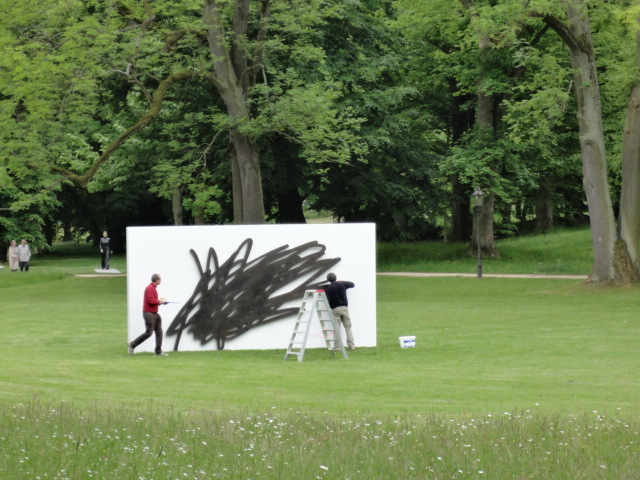
Workers attending to an exhibit at the Kurpark in Bad Homburg.
“Oh, god, would you just look at how beautiful these are,” my mother insisted, right through my mouth. I gave into the potato salad, to the pickles and the flowers. I wanted her there. Wanted to at least send her the picture of these plants she had planted at our Tennessee home, had propagated all over the “god damned” country, as she would have said in her rather-more-like-a-Southern-field-hand-than-a-lady way. I wanted the mother who grew beyond her lovely potato salad and straight out of homemaking to wear steel-toed boots to work, who gave me my first pocket knife, taught me how to drive a tractor, and insisted that every woman ought to know some basic things about plumbing.
These beautiful plants, were these the very ones the mafia had been using to move drugs from Japan to northern California in that complicated crime ring that involved my mother’s neighbors and her daughter’s Fulbright fellowship and ended in lithium on the psychiatric ward of a western North Carolina hospital?
Were these plants the ones that made it possible for her to get back out there again? To put it back together for another bunch of years, with a trip to English gardens, and with work in greenhouses at big nurseries in North Carolina and then in Florida, with her dog in tow and her swear words and that low whistle for the really “perfect specimen” before one too many cigarettes demanded its predictable payback?

Azaleas and rhododendrons in the Kurpark, Bad Homburg.
“They are just so, so beautiful,” I said to my son, as I snapped photo after photo.
“We could tell any crazy man who wants you, that this is the way to your heart. He could just buy you this,” Tieran said, quite out of the blue. You probably haven’t heard, but my love life hasn’t been so smooth lately. Of course, unable to protect himself from his crazy mother, Tieran knows this far too well. But, at just almost 12, so many things are affordable, so many things fixable.

A palace is always a welcome gift!
I don’t know. I don’t know crazy from sane. But I know that in those slightly-big, borrowed Converses on the lovely slopes of a wet German garden, I had everything I wanted for just a bit.

 wonderfuladventuretrip