I’ve just come through the second-to-
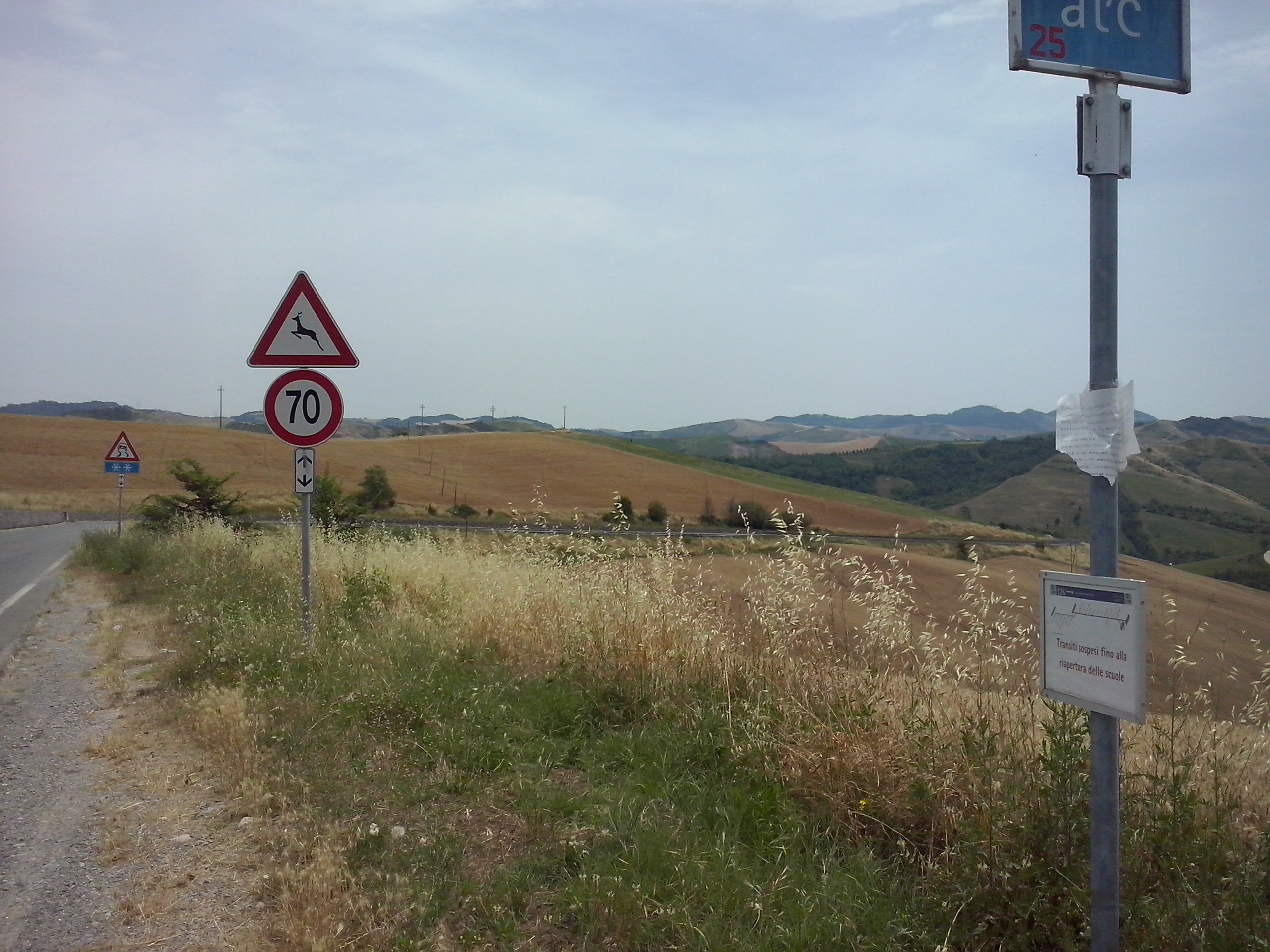 last roundabout when I hear the air escaping from my rear tire, almost a song of a sound as it rushes forward to the world released from the hot black inner tube, from the 110 pounds of pressure I had carefully pumped into it only two hours ago. I coast over to the edge of the road. I’m grateful this happened when I’m nearly back to Bologna, when I wasn’t going thirty miles an hour down a winding descent.
The ride had started out gloriously. I had gotten a bit high on the give and take between me and the cars and the motos and the buses, as I worked my way out of the historic city center toward the country roads. If I could have whistled (which I can’t) I would have whistled at the tightness of the traffic, at the sheer coolness of sliding over the ancient paving stones on my sleek bike, like a pro cyclist in the Giro d’Italia, at the negotiated chaos of roundabouts and the way we all, at every intersection almost collided but somehow didn’t. The hills were pretty. I was moving fast, and I liked seeing again all the other cyclists on the road. I was swept up into a rush of love for this city I had returned to just a few days before. I was thinking that, in fact, despite all my original doubts, I had made the right decision to spend more money than I have to flee Lexington and work here for a big part of my summer.
But now my damned tire has blown out.
Shit, I say to the narrow, unshaded sidewalk, to the enoteca closed for the midday break. Without the wind I had been creating by riding, the sweat suddenly pours down my face. My eyes are filled with rivulets of the expensive, no-chemical sunscreen I bought at the dermatologist when she treated the most recent sun damage on my face that wasn’t, not yet, cancer. I’m not crying, but I am because the stuff really stings. I can’t see well, and I wipe desperately at my eyes with the side of my sweaty riding gloves.
I consider calling in rescue. But who would I call? I only know a couple of people in Bologna who have cars, and they must be at work. If he weren’t at work, my “ragazzo” Paolo would probably ride out to me on his own bike and change my tire. He, too, is at work, though, an hour away. I want rescue, and I’m not going to get it.
I look down at my feet and notice that I’m standing in broken glass. It hasn’t been a great riding season so far. In early April, I had a terrible wreck when a dog ran into the road and took out the cyclist riding in front of me. I came out of it better off than my friend who broke his collarbone, seriously injured his hip and destroyed his bike. Still I was really bloodied up and had a kind of whiplash in my neck and shoulders that caused me real pain in almost any position for weeks.
A few days before I left for Italy another dog ran out in front of me. This time I was able to stop, and, nervous after the previous crash, I did. So, the dog came up to me and bit me. Hard. More than two weeks later, a gross purple and mustard colored lump the size of his bite sticks out of the side of my calf. Until recently, I was a little vain about my legs. Now Paolo says I look like a bad little girl who’s been out fighting in the streets.
The front door of a wine shop might not be the best place to change a bike tire. I carry the bike down to another space of sidewalk in front of an apartment building, and I pick up the few bits of junk I see that threaten to puncture the good tire. I sit down and unload the bits and pieces I’ll need for the job from my saddlebag. I’m really hot.
I’m really tempted to see this as the last straw, the final proof that I’ve gone too far and must give in. And I’m not thinking just of the cycling through which I’ve literally been losing bits of myself recently but also of a whole year of bites and blowouts in the rest of my life. When I last wrote a piece for this blog, I was not quite three months beyond a nasty breakup from the man I introduced to readers as “Sam” who had marched from my damp Bologna apartment in a freezing early March rain shouting obscenities that still ring in my ears. He would (does) have his own story. And, at any rate, it was the end of the longest romantic relationship of my life.
By the time I wrote about my mother’s potato salad and about her wisdom and her mental illness, I was settling out to be okay. I had a good summer. I started dating Paolo, a cyclist I met on one of the many long, lonely rides I did in the late spring when the rain finally lifted. He took me on real dates with lovely wine under the stars and music playing in romantic piazzas. We did some traveling, ate long meals, laughed hard, rode up and down mountains.
But going back to little Lexington was like taking a bath in ice water on a winter afternoon. Sam had found another, months earlier. Everyone knew, and no one wanted to be the one to tell me. The friends Sam and I had shared had pulled in his new girlfriend. There wasn’t space for me. They drove past my house, on their way to parties. I ate salad while I watched British murder mysteries on Netflix. I am a social person, a talker. I grew up in a big, noisy family. This new life seemed unsustainable.
Not fundamentally an ass and also understanding about the fact that I had been sort of swept out of my own life, Sam was nice enough to invite me to his birthday, an enormous bash, the last of two years of celebration of his turning 60. I thought it would be an opportunity for me to show the town how well I had taken the break up, how completely well I could handle myself, even in social situations with Sam and the new woman (really, really great, by all accounts).
I was nice enough to get very drunk (on a very fine bourbon). Then in the wee hours of the morning, before the small crowd remaining, I finally said all the things I had wanted to say in all of the years and all of the fights after all of the obscenities against which I had always thought it the best policy to stick to the facts, to avoid swear words, to try, relentlessly (doubtlessly, infuriatingly) to reason with him. Turns out, I had a lot to say. I even had a very clear response to Sam’s old habit of declaring when he was angry with me that I didn’t need him because I would soon find a younger man with a bigger, harder…Oh, yes, I had something to say about that, too. The bourbon was exceptional, but I was more—more memorable.
I truly regret it all, but maybe not for the reasons my audience of the evening thinks I should.
In the months that followed, I was both deserted and harassed by many of my former friends. One woman, who hadn’t been at the party for my coming out, came to my home and, in 15 ugly minutes told me I must “heal the town” by “doing the Hollywood thing and getting a therapist and calling in everyone and making my treatment public.” When I didn’t do that, she took it upon herself to “share her worries” about me with others. In one case I know about for sure, she did this in the afternoon pickup line for the elementary school. She really should run for office or start a clothing brand because she has a blood instinct for virus marketing.
Eventually I learned this Mean Girl had done a critical reading of my previous blog entries and explained to what another called a “small group of concerned Lexington women” how the blog showed my “18-month descent into serious mental illness.” As a third woman explained, it was clear from the potato salad essay that I was asking for help when I wrote in conclusion about my reflections on my mother, “I don’t know. I don’t know crazy from sane.” (For nearly a year now I have pondered the dangers of letting autobiographical writing loose on an audience of small town literalists. But I like to write.)
Despite their deep concern for me, these women didn’t come to see me. They didn’t want to have a beer together or think of asking me for dinner. In fact, on one occasion, Mean Girl made a very fancy scene of walking out of a restaurant when she discovered I was dining there. Her husband, always a gentleman, apologized by email later for any discomfort I must have felt.
Other “friends” came by on occasion to tell me how sorry they were that I had not been or would not be included in their social activities. They wanted me to know how bad they felt. They kindly reassured me that “with time” I would “find other friends.”
I was humiliated and lonelier than I had ever been in my life. The town seemed punishingly small. I was also insanely overcommitted at work and the mother of a busy 12-year-old. I didn’t have much “time” to find replacement friends. I walked the dog. I made dinners into which I tried to get as many nutrients as possible. I rode my biking, joining up on Sundays with a group of riders that no longer interested Sam. I got strong and fast.
I started going to church where I had brief after-church coffee chats with people who seemed gentle. I tried not to think they would turn on me if they heard about my horrible behavior at Sam’s party. In the nights when my future as a professor at a small conservative school in a town whose entire social life seemed to me then to be controlled by a woman whose self-righteous nastiness rivaled anything I had seen in my very miserable middle school years, I read the Bible, theology. I prayed. To learn to love my neighbors. It seemed, still seems, a very difficult thing.
Paolo, on a sort of work sabbatical, came for a long visit.
We were good together, but he had to go home because his job and life are in Italy. We have tried to stay together, but there is, literally, an ocean between us. Once burned, as they say, I fear this ocean and all the things we would have to do to cross it.
For months, even before the accident and the dog bite, it seemed to me as if I was bruised all over, as if I must walk very carefully through my life. My work went well. My child thrived. My dog loved me. I made dinner for old friends Sam hadn’t had much time for, friends I had missed. Paolo sent sweet texts.
I was lonely.
Years ago, during the sabbatical prior to the one that had brought me to Bologna, I had gone to Japan for four months, taking my then six-year-old son with me. We had an amazing time; we are both quite proud of all we did there. But living in a moldy (why, always moldy?) Tokyo apartment the size of my son’s bedroom in our American house and dealing with a new school and with all the stresses of Tokyo life, we had our bad moments, too. I remember one day coming back into the apartment after dropping Tieran off at school to find on the floor a letter he had started writing to his father the night before, when we had fought over his bedtime. “Help, Daddy,” the letter started. “Mommy’s being mean. I need rescuement.”
I still remember exactly how it felt to read that letter – my sense of horror at being “mean,” my joy to discover my son was suddenly writing complete sentences, my fascination with the word “rescuement.”
Many times in my life, when I have bumped up against something that really hurts and about which I can do nothing, my exhaustion in the middle of a long week of work and anxious parenting, the death of my beloved uncle Monte, something I have done of which I am ashamed, a friend’s illness, I have thought about Tieran’s letter. I have wished I could still write to my father. I have wished I could have rescuement, which has always seemed to me to be something different from and better than mere “rescue” that would be of help only in an acute and fundamentally escapable crisis. Yes, rescue we need at times. Rescuement, as I imagine it, however, is something more permanent, a state of being supported through the chronic meannesses of the human condition, and I feel like I really need it all the time.
*****
So, here I am on a Bolognese sidewalk in the heat of a June afternoon thinking about that idea of rescuement, trying not to feel lonely, trying to feel competent enough to get this inner tube replaced.
In more than four years of riding a road bike, this is only my second blowout. The first happened here, too, but more than twenty miles out of town up on the side of a mountain. I didn’t manage to repair it on my own. I had seen it done, had all the right equipment, including a fancy little container of compressed air for refills, but when I went to pump up the new inner tube, I inadvertently pressed the release valve on the compressed air dispenser before it was attached to the value of the inner tube. The all-essential air escaped into the valley below me.
Another cyclist stopped and tried to help me by pumping up my tire with a hand pump he carried, but it didn’t work. So I walked to a bar I’d seen a kilometer back down the road I’d come up. It wasn’t fancy, just a place for local men to get a coffee or a drink and a sandwich. I left my bike out front on a kind of porch and went inside to seek a solution. A pudgy, vague young man, really still more of a boy, in a shirt that said “Jackass” greeted me as I entered. Despite his less-than-promising label and uncertain face, he was quick to go in search of a pump. But what he brought me was for a commuter bike, not the sort capable of putting air into the narrow valve of my high-pressure tires. He tried, anyway, either to be nice, or because he didn’t really understand.
I bought a Coke and was considering asking for a bus ticket as well when the bar owner, probably in his late 50s, came in and quickly grasped the situation. He had a bike pump at his house that would work better, he said, and went off to get it. The right pump didn’t work either, and the bar owner declared that the new inner tube must also have a hole in it. He immediately pulled off the tire and proved his theory correct.
The lunch hour had started. Men passing through the area pulled up in work trucks and came in to buy little “aperitivo” drinks from the vague boy, sips of prosecco, Aperol, beer. At this point a small crowd had gathered around the bar owner and my bike. The group reached a general agreement that I should have brought two tubes with me, or at least a patch kit.
Given the situation, I was in no position to disagree. “It’s the first blow out I’ve ever had,” I said. “The inner tube is at least four years old.” They looked me over sternly and mercifully seemed to accept my chagrin as a sufficient apology for my stupidity.
The bar owner decided to try to patch one of my inner tubes with a piece of the other. He demanded scissors and glue, which appeared surprisingly quickly in the hands of “Jackass.” An old man came down from an attached apartment and wandered about, sometimes offering the bar owner advice, sometimes straying into the road. “Roberto, get out of the street,” the customers scolded reflexively. To Roberto’s suggestions about the tire, the bar owner said, “I know, I know! I’m already doing it!” with the irritation of a teenager talking to what must have been his father.
The patch, ingenious as it seemed, didn’t work. It popped off as soon as the bar owner put a bit of air into the tube. I eyed the bus stop outside the door. “Well, I guess I’m going to have to get a ticket,” I said.
“Cyclists do not go home on the bus!” the bar owner declared with a ferocity that nearly knocked me down. He turned to one of the men drinking prosecco and began quizzing him about where we might get me another inner tube.
“You probably didn’t know this guy raced many times in the Giro d’Italia,” another of the crowd said by way of explaining the bar owner’s intensity. “I was a lot lighter then,” the bar owner said gruffly, pointing his chin toward his beer belly. But, he said, almost whispered, he could once take this mountain we were on in a really high gear.
“She’s pretty light,” said one of the men, looking me up and down. “What do you weigh? No more than 50 kilos, right?” I kind of shrugged, not entirely sure where this irrelevant comparison would lead.
Eventually, someone came up with the name of a cyclist in the village, and the bar owner jumped into his car and road over to the cyclist’s house to get a new inner tube. When he came back, he suggested I leave a few euro to pay the cyclist for the gear, and so I emptied what remained in my pocket, what would have been my bus money, onto a table on the porch. Then, while Roberto, like a pro sports commentator, called out each step of the repair with an expertise he must have recalled from the days before he was wont to stray mindlessly into the road, the bar owner replaced the old tube with the new, put my tire back on and pumped it up.
“Be careful,” the bar owner said. “I can’t measure the pressure with this pump, and you can’t afford another blowout. Take the curves with caution.” I nodded, an obedient child.
I got on my bike and with the bar owner, Roberto, Jackass and five or six others watching and waving, I rode off, down the mountain, to Bologna.
Today, I am thinking about that day as I sit here on the sidewalk in the heat swearing and pulling at my clearly-in-need-of-replacement tire with raw, greasy hands. I don’t have the once-a-racer barman’s ease. Not yet. But he gave me something, something more than lots of help fixing that first flat.
Just as I am edging the last bit of the reluctant tire back into the wheel rim, two elderly men come out of the apartment building door. They are trimly dressed, off to lunch out at a favorite place, I bet.
They look down at me, and one of the men smiles and draws a bit of breath to speak.
I am sitting on the ground, and I have the bike tire wedged between my legs. Every inch of bare skin from my shorts to my ankles is smeared with black. The detritus of my efforts, tools, smashed crackers I had intended for a snack, the old tube, a dirty water bottle, and the new hand pump I bought because I don’t trust the fancy cartridges anymore are spread about me in the spectacular disorganization of the desperate neophyte. I pull in my shoulders a bit, ready for a smartass comment.
“Come brava!” he says–“How able you are!” “Vedremo!” (We’ll see.) I say. The men
laugh appreciatively and head off.
A few minutes later, I’m on my bike, pedaling slowly back into town, wary of the under-filled rear tire but also proud. I should have come to Italy with new tires. This one is actually ripped where whatever it was that popped the inner tube cut through it. I will have to go to a bike shop tomorrow and buy tires in euros. I could have maybe avoided this, if I had thought it through. But, I’m riding into the city now, back over the ancient stones. Cyclists go home on their bikes, I think. Rescuement.
 wonderfuladventuretrip