• About

wonderfuladventuretrip

~ From rooms of my own

wonderfuladventuretrip

Category Archives: bikes in Bologna

So. I’m back.

26 Monday Oct 2020

Posted by wonderfuladventuretrip in bikes in Bologna

≈ Leave a comment

It’s been years since I contributed to my own blog page, even though I’ve paid the fee each summer to maintain it. I got too busy, too happy, too involved in everything from running a community antiracism organization to raising my son and starting a new marriage.

And now I’m back only by chance. I need to practice doing this so that I can help the students in the “Material Culture of Protest” class I’m teaching set up a virtual exhibit about protest around statues.

So there. And because I love the Ginko, the tree where all the leaves turn and then fall all at once, but I also always feel a little sympathy for the nonconformist, here’s an image for my return.

How to blow out your bike tire in Bologna

01 Tuesday Jul 2014

Posted by wonderfuladventuretrip in bikes in Bologna

≈ Leave a comment

I’ve just come through the second-to-
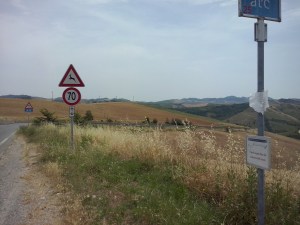
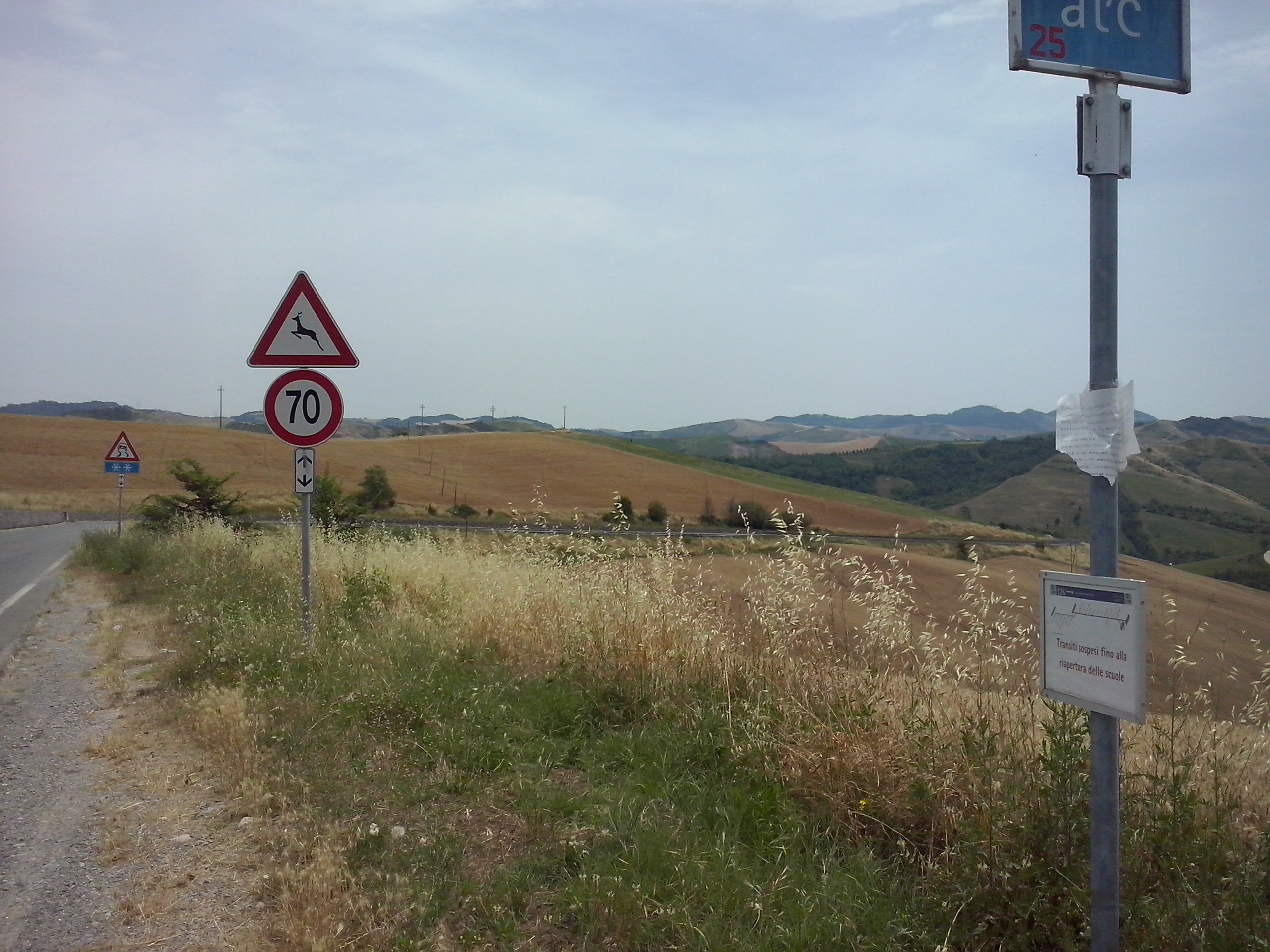
collinelast roundabout when I hear the air escaping from my rear tire, almost a song of a sound as it rushes forward to the world released from the hot black inner tube, from the 110 pounds of pressure I had carefully pumped into it only two hours ago. I coast over to the edge of the road. I’m grateful this happened when I’m nearly back to Bologna, when I wasn’t going thirty miles an hour down a winding descent.

The ride had started out gloriously. I had gotten a bit high on the give and take between me and the cars and the motos and the buses, as I worked my way out of the historic city center toward the country roads. If I could have whistled (which I can’t) I would have whistled at the tightness of the traffic, at the sheer coolness of sliding over the ancient paving stones on my sleek bike, like a pro cyclist in the Giro d’Italia, at the negotiated chaos of roundabouts and the way we all, at every intersection almost collided but somehow didn’t. The hills were pretty. I was moving fast, and I liked seeing again all the other cyclists on the road. I was swept up into a rush of love for this city I had returned to just a few days before. I was thinking that, in fact, despite all my original doubts, I had made the right decision to spend more money than I have to flee Lexington and work here for a big part of my summer.

But now my damned tire has blown out.

Shit, I say to the narrow, unshaded sidewalk, to the enoteca closed for the midday break. Without the wind I had been creating by riding, the sweat suddenly pours down my face. My eyes are filled with rivulets of the expensive, no-chemical sunscreen I bought at the dermatologist when she treated the most recent sun damage on my face that wasn’t, not yet, cancer. I’m not crying, but I am because the stuff really stings. I can’t see well, and I wipe desperately at my eyes with the side of my sweaty riding gloves.

I consider calling in rescue. But who would I call? I only know a couple of people in Bologna who have cars, and they must be at work. If he weren’t at work, my “ragazzo” Paolo would probably ride out to me on his own bike and change my tire. He, too, is at work, though, an hour away. I want rescue, and I’m not going to get it.

I look down at my feet and notice that I’m standing in broken glass. It hasn’t been a great riding season so far. In early April, I had a terrible wreck when a dog ran into the road and took out the cyclist riding in front of me. I came out of it better off than my friend who broke his collarbone, seriously injured his hip and destroyed his bike. Still I was really bloodied up and had a kind of whiplash in my neck and shoulders that caused me real pain in almost any position for weeks.

A few days before I left for Italy another dog ran out in front of me. This time I was able to stop, and, nervous after the previous crash, I did. So, the dog came up to me and bit me. Hard. More than two weeks later, a gross purple and mustard colored lump the size of his bite sticks out of the side of my calf. Until recently, I was a little vain about my legs. Now Paolo says I look like a bad little girl who’s been out fighting in the streets.

The front door of a wine shop might not be the best place to change a bike tire. I carry the bike down to another space of sidewalk in front of an apartment building, and I pick up the few bits of junk I see that threaten to puncture the good tire. I sit down and unload the bits and pieces I’ll need for the job from my saddlebag. I’m really hot.

I’m really tempted to see this as the last straw, the final proof that I’ve gone too far and must give in. And I’m not thinking just of the cycling through which I’ve literally been losing bits of myself recently but also of a whole year of bites and blowouts in the rest of my life. When I last wrote a piece for this blog, I was not quite three months beyond a nasty breakup from the man I introduced to readers as “Sam” who had marched from my damp Bologna apartment in a freezing early March rain shouting obscenities that still ring in my ears. He would (does) have his own story. And, at any rate, it was the end of the longest romantic relationship of my life.

By the time I wrote about my mother’s potato salad and about her wisdom and her mental illness, I was settling out to be okay. I had a good summer. I started dating Paolo, a cyclist I met on one of the many long, lonely rides I did in the late spring when the rain finally lifted. He took me on real dates with lovely wine under the stars and music playing in romantic piazzas. We did some traveling, ate long meals, laughed hard, rode up and down mountains.

But going back to little Lexington was like taking a bath in ice water on a winter afternoon. Sam had found another, months earlier. Everyone knew, and no one wanted to be the one to tell me. The friends Sam and I had shared had pulled in his new girlfriend. There wasn’t space for me. They drove past my house, on their way to parties. I ate salad while I watched British murder mysteries on Netflix. I am a social person, a talker. I grew up in a big, noisy family. This new life seemed unsustainable.

Not fundamentally an ass and also understanding about the fact that I had been sort of swept out of my own life, Sam was nice enough to invite me to his birthday, an enormous bash, the last of two years of celebration of his turning 60. I thought it would be an opportunity for me to show the town how well I had taken the break up, how completely well I could handle myself, even in social situations with Sam and the new woman (really, really great, by all accounts).

I was nice enough to get very drunk (on a very fine bourbon). Then in the wee hours of the morning, before the small crowd remaining, I finally said all the things I had wanted to say in all of the years and all of the fights after all of the obscenities against which I had always thought it the best policy to stick to the facts, to avoid swear words, to try, relentlessly (doubtlessly, infuriatingly) to reason with him. Turns out, I had a lot to say. I even had a very clear response to Sam’s old habit of declaring when he was angry with me that I didn’t need him because I would soon find a younger man with a bigger, harder…Oh, yes, I had something to say about that, too. The bourbon was exceptional, but I was more—more memorable.

I truly regret it all, but maybe not for the reasons my audience of the evening thinks I should.

In the months that followed, I was both deserted and harassed by many of my former friends. One woman, who hadn’t been at the party for my coming out, came to my home and, in 15 ugly minutes told me I must “heal the town” by “doing the Hollywood thing and getting a therapist and calling in everyone and making my treatment public.” When I didn’t do that, she took it upon herself to “share her worries” about me with others. In one case I know about for sure, she did this in the afternoon pickup line for the elementary school. She really should run for office or start a clothing brand because she has a blood instinct for virus marketing.

Eventually I learned this Mean Girl had done a critical reading of my previous blog entries and explained to what another called a “small group of concerned Lexington women” how the blog showed my “18-month descent into serious mental illness.” As a third woman explained, it was clear from the potato salad essay that I was asking for help when I wrote in conclusion about my reflections on my mother, “I don’t know. I don’t know crazy from sane.” (For nearly a year now I have pondered the dangers of letting autobiographical writing loose on an audience of small town literalists. But I like to write.)

Despite their deep concern for me, these women didn’t come to see me. They didn’t want to have a beer together or think of asking me for dinner. In fact, on one occasion, Mean Girl made a very fancy scene of walking out of a restaurant when she discovered I was dining there. Her husband, always a gentleman, apologized by email later for any discomfort I must have felt.

Other “friends” came by on occasion to tell me how sorry they were that I had not been or would not be included in their social activities. They wanted me to know how bad they felt. They kindly reassured me that “with time” I would “find other friends.”

I was humiliated and lonelier than I had ever been in my life. The town seemed punishingly small. I was also insanely overcommitted at work and the mother of a busy 12-year-old. I didn’t have much “time” to find replacement friends. I walked the dog. I made dinners into which I tried to get as many nutrients as possible. I rode my biking, joining up on Sundays with a group of riders that no longer interested Sam. I got strong and fast.

I started going to church where I had brief after-church coffee chats with people who seemed gentle. I tried not to think they would turn on me if they heard about my horrible behavior at Sam’s party. In the nights when my future as a professor at a small conservative school in a town whose entire social life seemed to me then to be controlled by a woman whose self-righteous nastiness rivaled anything I had seen in my very miserable middle school years, I read the Bible, theology. I prayed. To learn to love my neighbors. It seemed, still seems, a very difficult thing.

Paolo, on a sort of work sabbatical, came for a long visit.

We were good together, but he had to go home because his job and life are in Italy. We have tried to stay together, but there is, literally, an ocean between us. Once burned, as they say, I fear this ocean and all the things we would have to do to cross it.

For months, even before the accident and the dog bite, it seemed to me as if I was bruised all over, as if I must walk very carefully through my life. My work went well. My child thrived. My dog loved me. I made dinner for old friends Sam hadn’t had much time for, friends I had missed. Paolo sent sweet texts.

I was lonely.

Years ago, during the sabbatical prior to the one that had brought me to Bologna, I had gone to Japan for four months, taking my then six-year-old son with me. We had an amazing time; we are both quite proud of all we did there. But living in a moldy (why, always moldy?) Tokyo apartment the size of my son’s bedroom in our American house and dealing with a new school and with all the stresses of Tokyo life, we had our bad moments, too. I remember one day coming back into the apartment after dropping Tieran off at school to find on the floor a letter he had started writing to his father the night before, when we had fought over his bedtime. “Help, Daddy,” the letter started. “Mommy’s being mean. I need rescuement.”

I still remember exactly how it felt to read that letter – my sense of horror at being “mean,” my joy to discover my son was suddenly writing complete sentences, my fascination with the word “rescuement.”

Many times in my life, when I have bumped up against something that really hurts and about which I can do nothing, my exhaustion in the middle of a long week of work and anxious parenting, the death of my beloved uncle Monte, something I have done of which I am ashamed, a friend’s illness, I have thought about Tieran’s letter. I have wished I could still write to my father. I have wished I could have rescuement, which has always seemed to me to be something different from and better than mere “rescue” that would be of help only in an acute and fundamentally escapable crisis. Yes, rescue we need at times. Rescuement, as I imagine it, however, is something more permanent, a state of being supported through the chronic meannesses of the human condition, and I feel like I really need it all the time.

*****

So, here I am on a Bolognese sidewalk in the heat of a June afternoon thinking about that idea of rescuement, trying not to feel lonely, trying to feel competent enough to get this inner tube replaced.

In more than four years of riding a road bike, this is only my second blowout. The first happened here, too, but more than twenty miles out of town up on the side of a mountain. I didn’t manage to repair it on my own. I had seen it done, had all the right equipment, including a fancy little container of compressed air for refills, but when I went to pump up the new inner tube, I inadvertently pressed the release valve on the compressed air dispenser before it was attached to the value of the inner tube. The all-essential air escaped into the valley below me.

Another cyclist stopped and tried to help me by pumping up my tire with a hand pump he carried, but it didn’t work. So I walked to a bar I’d seen a kilometer back down the road I’d come up. It wasn’t fancy, just a place for local men to get a coffee or a drink and a sandwich. I left my bike out front on a kind of porch and went inside to seek a solution. A pudgy, vague young man, really still more of a boy, in a shirt that said “Jackass” greeted me as I entered. Despite his less-than-promising label and uncertain face, he was quick to go in search of a pump. But what he brought me was for a commuter bike, not the sort capable of putting air into the narrow valve of my high-pressure tires. He tried, anyway, either to be nice, or because he didn’t really understand.

I bought a Coke and was considering asking for a bus ticket as well when the bar owner, probably in his late 50s, came in and quickly grasped the situation. He had a bike pump at his house that would work better, he said, and went off to get it. The right pump didn’t work either, and the bar owner declared that the new inner tube must also have a hole in it. He immediately pulled off the tire and proved his theory correct.

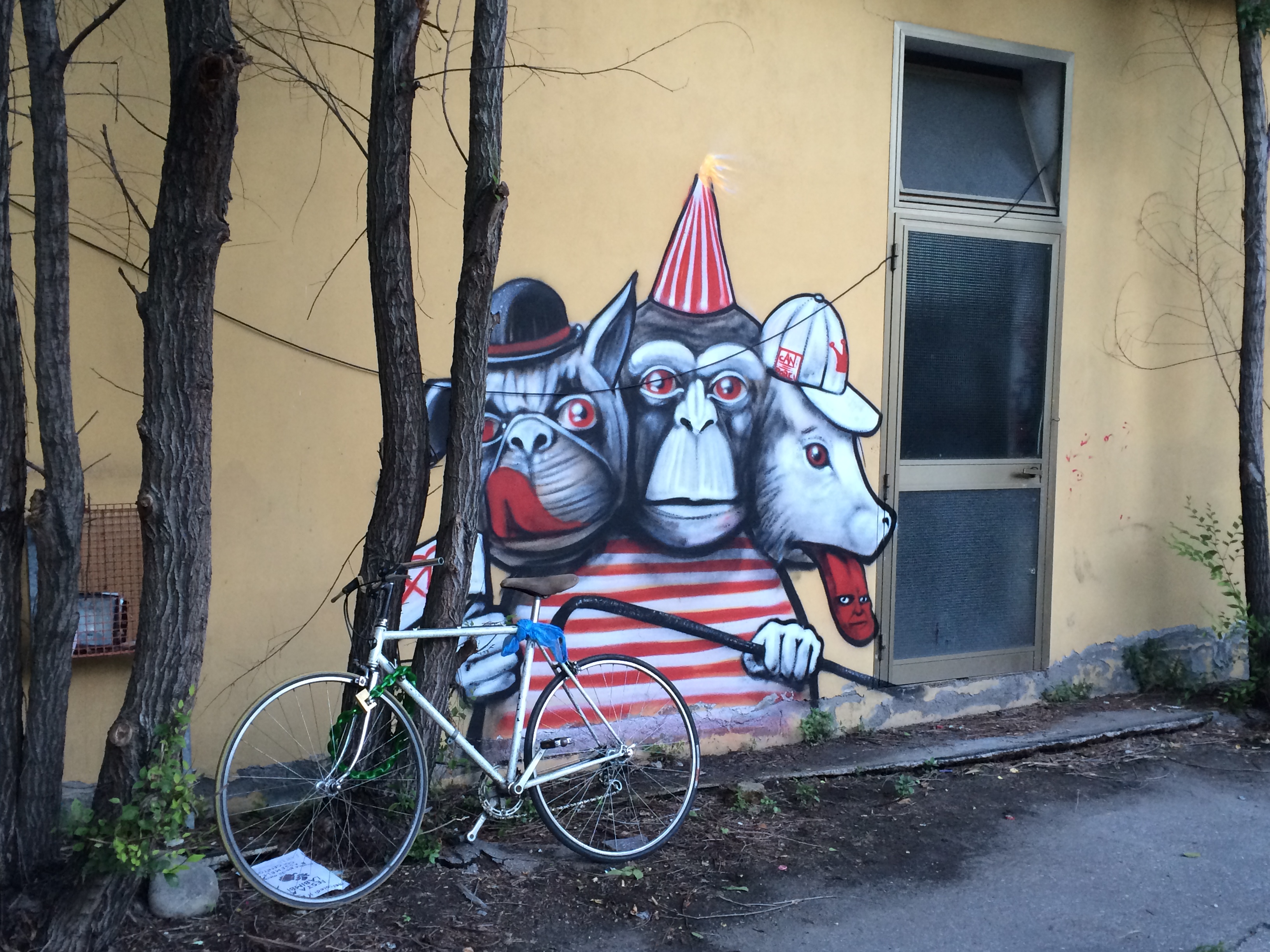
The lunch hour had started. Men passing through the area pulled up in work trucks and came in to buy little “aperitivo” drinks from the vague boy, sips of prosecco, Aperol, beer. At this point a small crowd had gathered around the bar owner and my bike. The group reached a general agreement that I should have brought two tubes with me, or at least a patch kit.IMG_1494
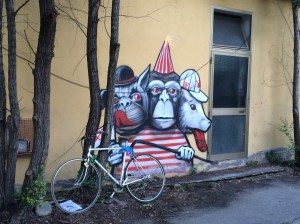
Given the situation, I was in no position to disagree. “It’s the first blow out I’ve ever had,” I said. “The inner tube is at least four years old.” They looked me over sternly and mercifully seemed to accept my chagrin as a sufficient apology for my stupidity.

The bar owner decided to try to patch one of my inner tubes with a piece of the other. He demanded scissors and glue, which appeared surprisingly quickly in the hands of “Jackass.” An old man came down from an attached apartment and wandered about, sometimes offering the bar owner advice, sometimes straying into the road. “Roberto, get out of the street,” the customers scolded reflexively. To Roberto’s suggestions about the tire, the bar owner said, “I know, I know! I’m already doing it!” with the irritation of a teenager talking to what must have been his father.

The patch, ingenious as it seemed, didn’t work. It popped off as soon as the bar owner put a bit of air into the tube. I eyed the bus stop outside the door. “Well, I guess I’m going to have to get a ticket,” I said.

“Cyclists do not go home on the bus!” the bar owner declared with a ferocity that nearly knocked me down. He turned to one of the men drinking prosecco and began quizzing him about where we might get me another inner tube.

“You probably didn’t know this guy raced many times in the Giro d’Italia,” another of the crowd said by way of explaining the bar owner’s intensity. “I was a lot lighter then,” the bar owner said gruffly, pointing his chin toward his beer belly. But, he said, almost whispered, he could once take this mountain we were on in a really high gear.

“She’s pretty light,” said one of the men, looking me up and down. “What do you weigh? No more than 50 kilos, right?” I kind of shrugged, not entirely sure where this irrelevant comparison would lead.

Eventually, someone came up with the name of a cyclist in the village, and the bar owner jumped into his car and road over to the cyclist’s house to get a new inner tube. When he came back, he suggested I leave a few euro to pay the cyclist for the gear, and so I emptied what remained in my pocket, what would have been my bus money, onto a table on the porch. Then, while Roberto, like a pro sports commentator, called out each step of the repair with an expertise he must have recalled from the days before he was wont to stray mindlessly into the road, the bar owner replaced the old tube with the new, put my tire back on and pumped it up.

“Be careful,” the bar owner said. “I can’t measure the pressure with this pump, and you can’t afford another blowout. Take the curves with caution.” I nodded, an obedient child.

I got on my bike and with the bar owner, Roberto, Jackass and five or six others watching and waving, I rode off, down the mountain, to Bologna.

Today, I am thinking about that day as I sit here on the sidewalk in the heat swearing and pulling at my clearly-in-need-of-replacement tire with raw, greasy hands. I don’t have the once-a-racer barman’s ease. Not yet. But he gave me something, something more than lots of help fixing that first flat.

Just as I am edging the last bit of the reluctant tire back into the wheel rim, two elderly men come out of the apartment building door. They are trimly dressed, off to lunch out at a favorite place, I bet.

They look down at me, and one of the men smiles and draws a bit of breath to speak.

I am sitting on the ground, and I have the bike tire wedged between my legs. Every inch of bare skin from my shorts to my ankles is smeared with black. The detritus of my efforts, tools, smashed crackers I had intended for a snack, the old tube, a dirty water bottle, and the new hand pump I bought because I don’t trust the fancy cartridges anymore are spread about me in the spectacular disorganization of the desperate neophyte. I pull in my shoulders a bit, ready for a smartass comment.

“Come brava!” he says–“How able you are!” “Vedremo!” (We’ll see.) I say. The men
laugh appreciatively and head off.

A few minutes later, I’m on my bike, pedaling slowly back into town, wary of the under-filled rear tire but also proud. I should have come to Italy with new tires. This one is actually ripped where whatever it was that popped the inner tube cut through it. I will have to go to a bike shop tomorrow and buy tires in euros. I could have maybe avoided this, if I had thought it through. But, I’m riding into the city now, back over the ancient stones. Cyclists go home on their bikes, I think. Rescuement.


Under the Bolognese rains…

24 Sunday Mar 2013

Posted by wonderfuladventuretrip in bikes in Bologna

≈ Leave a comment

Dearest reader, we are sorry we have abandoned you. But it has been raining in Bologna.

Since November.

First with off and on drizzles and occasional horrible downpours that gave promise of clearing soon. Then in steady, hard-working unfancy wetness. Followed by weeks of wintry mix (the name of a dessert that isn’t) sticking up sidewalks, making black-brown slushees of the stuff kicked up by accelerating buses. Then arriving in driving, icy needles piercing our shiny, puffy overcoat, freezing on our umbrella. At last coming down as sheer misery among the dog poops that no wet owners would pick up. It has been raining and cold and sometimes snowing and at best offering grey, low, damp, ultraheavy clouds under which one might scurry to the shopping between rains, dancing around the dog poops, spreading always from the rain that has just fallen on them.

Since November.

We have tried our best. We have drunk hot chocolates more like stews served with full cups of whipped cream (panna montata, unabashed mountains of cream, we can’t help thinking). We have tried lunches of tagliatelle al ragu or octopus-potato salad at the top floor of Eataly, under the drenched, modern skylights that brilliantly accent the medieval setting outside. We have sipped our broth and savored our prosciutto-filled tortellini.

We have hiked up the world’s longest portico from the Saragozza gate at the southeast of Bologna’s historic center to the shrine of the icon of Madonna of San Luca. She performed the miracle of stopping the torrential rains of 1433, but she has been on vacation ever since. The four-kilometer portico connecting 15 chapels by 666 arches up a very steep hillside was built in the early 1700s to allow the faithful to bring her down dry to the main church on the center piazza in her annual procession, despite the expected and ancient soaking weather.

Absent divine meteorological intervention, we graduated to ridiculous lunches at an enoteca with a carta di vini longer than War and Peace and Irish coffees at sunset (at 4:45) at the very elegant café Zanarini.

A careful attention to the qualities of a mid-priced Barbera followed by somber examination of a trio of purple-blue cheeses against a glass of vin santo does help to discipline the dragging edges of one’s mood. Alas, few have livers built for drinking their way out of a Bolognese winter.

Finally, really we have simply given in. We have sobbed our way around the dog mess en route to spin class in a gym overcrowded with middle-aged women bitching about the endless winter. We have moaned over the colander of draining pasta and dripped into the afternoon teas that have not been sustaining. And we have used a lot of bleach to beat back the mold that simply won’t be put off in a city that is wet, wet, wet, but not, really, all that cold.

But we have not been writing, because, dearest reader, we are more like the Wicked Witch of the West than we would like to admit. And damnit, in enough water, we melt.

So, I’m sorry. I have had things I should have wanted to say. But, look, even the Pope walked out. The whole, entire nation has been soggy in soul and body. A week before the recent parliamentary elections, a taxi driver taking me (yes, in the rain) to a speaking engagement told me he hoped the whole lot of incumbents would be sent home. “A real rottamazione?” I asked, using the word that a 37-year-old young upstart in the center-left Democratic Party, mayor of Florence, popularized a little over a year ago in a call for national-level leadership change. Rottamazione: a term which, according to Lo Zingarelli, the standard of Italian dictionaries, was previously used mostly for describing the process of junking old cars to recycle their useful bits. “Yes, a rottamazione,” said the taxi driver. “We couldn’t end up with anyone worse than we have now.”

His sentiments were echoed by seemingly everyone I met. The slow-building rage at the weather that infected political scientists and café owners alike was topped only by the widespread agreement that all of the politicians who held office deserved to be sent “a casa” (back home).  “They rob us, they rob us, they rob us, and then they want more taxes, but we don’t have any money,” was one—or in a certain sense—every response I would get to my stupid but unfailingly provocative, “I don’t understand what’s going on in Italian politics today.”

The anger was interesting to me. Of course, it should have been, given that the analysis of grass-roots political consciousness is literally my entire career and, at base, the sole reason I am living here in Italy. But eventually the rain dampened even my lifelong curiosity to such an extent that, by Tuesday night, all I could think was, “I’m done. I’m done with Italy. I want to go home.”  Actually I keened this, rocking slowly back and forth in a kitchen where I couldn’t think of a single thing I wanted to eat for dinner. If I were not the mother of a perpetually hungry 11-year-old boy, I would have crawled in bed, downloaded a Grisham novel to my Kindle and stayed there for the foreseeable future. Downton Abbey was unfortunately not an option; I used that to get through February.

Intellectually, I know there must have been days like this in the first year or two of my relationship with Japan. I remember moments. I remember sitting, on a July afternoon, in a campaign office set up on the fourth floor of a building in central Tokyo that was scheduled for demolition as soon as the elections concluded and we moved out. There was no air-conditioning, so the office managers had resorted to a climatization trick of a different era.

They had an ice manufacturer bring in a giant block of ice. Behind the ice they placed a fan that blew the hot air over the ice, melting it, spewing moist, cooler air into the room beyond. My pale ultra-wasp face must have been red with the heat because the campaign workers with whom I had been addressing envelopes moved me to a seat directly in front of the ice. The aging women in the office waxed nostalgic about the early postwar days in which a fan and a block of ice had seemed a luxury.

To me the increased humidity caused by the melting ice obliterated the comfort of the cooler air. Not the least bit grateful for my prime seat, I gave up on work and headed at a determined pace to a large public pool to swim laps. But the pool was so crowded I couldn’t manage the laps. First, I had to keep stopping to tread water in order to avoid running into the person in front of me. When I changed to a faster lane, I was clobbered from behind by a man considerably abler than I. On a turn at the end of the pool, the life guard stopped me and tried to explain what the lane rules were. In tears, I simply got out of the pool and ran to the locker room where I sat on the floor huddled in a corner sobbing loudly until I decided that I would rather dry myself off and head home to my sweaty 10 x 6 apartment than be gently carried away to an asylum by concerned fellow swimmers. These days, it feels like it would have been so much easier to return to Japan for my sabbatical than to start all over in a new country, but back then Japan must have been hard, too.

Yes, I see the theme. I am a weather wimp. I admit this freely. I have always wanted to live in San Francisco where the temperature would always be right, where sun might carry me through midday and fog lull me to sleep at night. Yeah. Well. I should have picked a different career. But to be fair, I did betray Japan for Italy, and I did it fully convinced that the lovely weather I had seen in Rome so many times would be a pleasure. This year, even in Rome, the city Italians declare has a famously beautiful climate, it has been raining an extraordinary amount. Did I mention that the Pope quit his job?

To sum up, by early last week, I had reached a state of weather-induced neurosis such that my thoughts revolved incessantly around the worry that my research has stalled out (I am trying to branch out to a new segment of society, the precariat young people, and I’m finding it hard to pin them down for interviews, maybe because their lives are precariously organized), the sense of being at times intensely lonely (I have only a few friends, and they are, like middle-aged people everywhere, busy with work and children and…), and, and well, my rage against dog owners who will not remove their pets’ deposits from my walkway.  The tortuous construction of the previous sentence does not begin to reflect the tortuous circles of my mind.

Just a brief digression: in early December I interviewed a local official who is also a noted urban planning scholar and architect. She is graceful, accomplished–intimidating, frankly. But partway through the interview, as she was describing the city’s approach to managing populations of disaffected youth who live in the streets or occupy abandoned factories, she paused to insist with what I naively thought of as uncharacteristic abandon that, if young people taking drugs in a piazza near the university are a public nuisance, equally are the bourgeois ladies of the more upscale neighborhoods who do not clean up the “cacca” of their pooches. At the time, only a week or two into the rains, I thought the urban planner was exaggerating the comparison for the sake of some sort of political correctness toward young people. Now, I know better.

Back to my story. On Thursday, the sun came out, not for an hour or two but for a whole, warm day. We woke to a shocking blue sky. After I took Tieran to school, I dragged my road bike from the basement and headed for the hills. Everyone was out. At each of the five roundabouts I have to pass to get out of town, there were more cyclists than motor vehicles! The terrain rose up around me greener than I could imagine. Pools of water still swamped the low-lying fields but sprouts of something promising poked their way up through the puddles. The tree below the apartment balcony burst into bloom. I discovered that the park near our house is rimmed in forsythia, not wet sticks, after all.

On Friday morning there was sun again. Italy had formed, tentatively, a sort of government out of the mishmash of parties that came out of the angry election (the low turnout for which has been blamed partly on the rain and snow that fell across the country that day). My son, who had been absolutely distrustful of the break in the rain on Thursday, came home from school Friday wreathed in smiles. He suggested a walk. We zigzagged through our neighborhood, noting all the heavy buds on the deciduous magnolias, the trees that always break my heart by showing their stuff too early in the more variable springs of Virginia and getting burnt into brown in the frost. Here they will bloom safely.

We pointed out to each other our favorite buildings, examples of late 19th century architecture, of early 20th century modernism, the charming bits of fresco below the roofs, the rounded balconies and 1930s porch rails. We each chose the villas we would buy if only. I made him promise to get me an apartment with a terrace garden just outside the city walls when he grows up and gets rich.

We ended our walk at the little park just a half block from our apartment, in front of the gelateria-bar where at 11 p.m. on our first night here in August, I had breathlessly procured water, Coke, beer, in that first ritual of settlement. The establishment is really no more than a biggish cart with an adjacent terrace shaded by a vinyl tent. It closed in October and had sat abandoned for months under slowly spreading mildew.

But on Friday afternoon, we saw the mildew had been scrubbed away. The curtains of the tent had been pulled back, and the chairs and tables, stacked away last fall were now spread out.  A line of mothers, grandmothers, and children jabbered at the service window. “When did you open,” they all asked the owner. “Today!” she chanted as she doled out scoops of pistachio, strawberry, chocolate chip, cream, and hazelnut. The grownups were definitively more thrilled even than the children who bounced and whooped through the park. And at home, in front of the apartment, some mysterious future saint had removed the massive pile of dog mess that had been there for days, fueling my grim winter mood as surely as yak dung heats a Tibetan tent (this according to a friend who knows).

Yesterday morning, Saturday, also dawned with sun. But by now I was beginning to wish for others with whom we might share it, some adult with whom to have a glass of wine or beer and a long, Saturday conversation. I felt my alienness, knew the truth of the limits of trying “live” in a foreign town for a mere 10 months, not really time enough to establish one’s own social space, too long to get by simply on calls home and the novelty of a new culture.

Tieran and I headed into the historic center on foot. We still had a little bit of the joy of re-seeing the city again. But I could also now feel that the strain of being here was more than a problem of weather. Then, the phone rang. It was another single mom, Bolognese woman my age with a child Tieran’s age I had met months ago. She apologized. They had been so busy, and she never managed to call us even though they really hoped to see us. By any chance would we be free for lunch? Of course, we were!

On the way to her house, I bought a really decent local cabernet for less than six euro on the recommendation of a wine dealer who has never done me wrong, not for six, nor for 30. We got a collection of pastries at a lovely shop in heart of the center.

We ate a simple pasta, and the other mother and I talked for hours: men, politics, the church, the possibilities of reincarnation, the impossibility of ridding a Bolognese home of mold. My son and hers played soccer in a nearby churchyard. A bit before we started home, the rain started up again. The fresh-washed clothes I had hopefully hung on the line off the balcony were doubtless already soaked.  The weather looked to have moved in for sometime to come. “I am going back to bed until next Friday,” was the text message an American friend here sent me. She means it, I thought.

And yet.

We wandered under the beautiful Bologna-orange porticoes to a stop for our bus. One was late, and so two came at once. We jumped on the second and had, as we almost never do, two seats.

At home, I hung the soggy laundry over the radiators and put some chicory on to boil for supper. I would serve it with spaghetti alla carbonara. I already had eggs and pancetta, and I had no intention of shopping in the rain. Then, I opened a book that the American friend, taken to bed in a protest against rain, had bought me a week ago when she was still willing to venture out. Elogio dell’invecchiamento: alla scoperto dei dieci migliori vini italiani (e di tutti i trucchi dei veri sommelier) (An Elegy for Aging: Discovering the 10 Best Wines of Italy (and all the tricks of real sommeliers)) by Andrea Scanzi.

At the beginning of the chapter on the wines of the Piedmont region, Scanzi suggests that the reader, while working her way through the next section, drink a famous Dolcetto and listen to Keith Jarrett’s jazz. I didn’t have the famous wine recommended by Scanzi, but I poured myself a glass of what the reliable wine dealer had told me was a decent Dolcetto at a shockingly low price. And I set my iTunes to Jarrett’s Solo Concerts, Bremen.

My cheap version of the wine was good enough but not all of the things that, according to Scanzi, it might be. Still, I understood perfectly what he was saying about Jarrett, and about the mountains in which one of his particularly favorite vintners might be found, about playing, repeatedly, with the same note (or finicky grape), with something hard that doesn’t yield its secrets easily, that takes time, that is demanding, frustrating, risky, inevitably vulnerable to bad weather, impossible to describe. And sometimes, also, worth the trouble.

Yes, dear reader, it is still raining.


Palazzo Pazzo: Life is craaazy good here!

18 Thursday Oct 2012

Posted by wonderfuladventuretrip in bikes in Bologna

≈ 1 Comment

For readers of “From Chari to Bici,” this is a second installment in the great drama of bikes at my building. For the sake of coherence, I repeat bits you might already know from the previous post at the beginning of this one.

One thing I did not anticipate about studying community life in ageing Bologna is that I would become the focus of a multi-generational dispute among my neighbors! But in fact my bicycles (one for me, one for my son, one for my boyfriend) and I are the precipitating factor in a small but growing war in my palazzo (apartment building) between some of the elderly residents and the middle-aged residents and their children.

A male resident, whom I would guess is about 70, and his wife are enraged over the fact that we have been parking our bicycles in the so-called garden behind the apartment building. The man, who would not introduce himself even when I insisted upon it, tried yelling at me about the bicycles from his balcony one afternoon, demanding that I put them in the cantina in the basement, declaring I am destroying the “garden” (four large potted plants on one side of a large gravel yard that runs the length of the building) he has maintained for 20 years. He threatened me with claims that I will be hauled before the “justice system,” but my landlord and several other residents have insisted to me that I have every right to park my bikes there.

A week or so after he harangued me, the man’s wife accosted me on the street when I was locking the garden gate after parking my bike. She asked me who told me I could put my bikes back there. I told her that my landlord had assured me it was okay, and shaking her finger in my face, she began to yell “lies, lies!” Just as I was trying to tell her I was sorry she was so angry, another building resident walked up and told her to leave me alone. The wife marched off to her apartment in a huff. We still say good morning and good evening when we run into each other in the hallway, but the greetings have a certain chill in them.

From what I hear, the residents have had long and unpleasant experience with the anti-bike couple, but the agreed-upon strategy seems to be to simply ignore the angry husband and wife when at all possible. They are old and direct argument with them is probably of no use, residents tell me. I hear this analysis as both a desire to avoid conflicts and a genuine wish to be accommodating of the limits of the elderly. To protect this approach to the problem, several residents have stepped in to talk to the man on my behalf, and they have tried to suppress the expansion of the conflict by emphasizing to him my inaccessible foreignness, despite the fact that I have spoke with both husband and wife at length in Italian.

The college-student daughter of my neighbor from across the hall speaks English, and she tells me that maybe the guy has Alzhimer’s and assures me that I can call on her or others in her family for assistance if the man should cause me any trouble. Her mother says he is old and crazy and that I should just keep telling him and his wife that I don’t speak Italian. She says this to me in Italian just after expressing her surprise that I “understand everything she says.”

The woman in the apartment next door to mine has apologized for the fact that I must live in a palazzo with such a “pazzo.” My landlord describes the couple as “completely insane.” She reassures me that she has called to tell the couple that I have absolutely no Italian whatsoever, so there is no use in speaking to me. The couple does not pursue a further conversation with me.

Still, the tension builds. Three days ago there was an insistent ringing at my door buzzer. I was exhausted from a bad cold, and I was trying to take a nap. I was not awaiting any packages or guests, and I don’t really know anyone yet who might drop by unexpectedly. Most days the buzzing is from guys who have come to stuff the palazzo mailboxes full of pizza delivery fliers and are hoping I’ll let them in the building entrance so they can do that. I had ignored three buzzers earlier in the day. But I was getting the sense that this was not merely an obstructed advertiser.

Finally, I asked my son to answer the buzzer. “It’s a lady who is downstairs and wants you to come down,” he reported. Still hoping for a nap, I sent him to go see what she wanted. He came back. “She wants to switch mailboxes with you, and she wants me to give her your keys.”

Somewhat disbelieving and annoyed to be roused from the edge of what would have been a glorious stolen hour, I marched downstairs.

The woman, the next-door neighbor of the crazy, anti-bike guy, repeated everything she had told my son. She explained that many years ago she had hurt her shoulder, and she had been unable to reach the higher number 2 mailbox assigned to her apartment. Now her arm was better, and she wanted to move back to number 2. I should move to the lower box 12, the box she was using. Number 12 was the same as the number on my apartment, so the move made sense, she pointed out. There would be no problem at all in changing boxes, she insisted. “Give me your key and take down your name and move it,” she said, and then, almost as an afterthought she added, “What is your name? This is you, right?”

“What is your name?” I asked, “I’m Veltroni,” she said, giving me only a last name, not bothering to express pleasure at meeting me. I wondered if I would ever get to put into use the lessons on self introductions and polite meetings from the initial chapter of my Italian language textbook.

“I don’t understand,” I said. She looked at my son. “You understand me, don’t you,” she asked him. He nodded, eyes big.

“I understand what you said,” I restated, “but I don’t understand why I have to change with you.” “It’s a condominium regulation,” she said.

“I’m not the owner of the apartment,” I tried explaining. “Adriana, the owner, told me that my box was box 2,” I said. “Who’s Adriana?” the mailbox lady asked. Then she repeated that there was not a single problem in moving the boxes. The mailman would figure things out. For many years she hadn’t be able to use the box, but now it was time to change.

“How many years?” I asked. “Twenty years,” she replied. “Twenty years?” I asked, just to make sure I wasn’t missing something in the Italian. Twenty years.
I tried to ask her why she must change the box now, at 4:00 on a Tuesday afternoon. “Condominium regulations,” she replied. Somewhere in the middle of this she dropped some papers she was holding. “Could you get them for me?” she asked. “I can’t move my shoulder.”

My son and I, very confused, picked up the papers. I couldn’t think of any especially firm reason for not changing boxes, so I told the mailbox lady to go get her keys. Then I switched boxes with her. I put my name up on the new box in a bigger label, hoping the postman would quickly see that I was still there among the residents.

The next afternoon, the pazzo anti-bike man put a note up on the front door of the palazzo. In it he addressed a “stronzo” or “stronza,” (a vulgar word that can also describe excrement) whoever it might be, he said, who was responsible for putting dog poop in front of his “studino” (I think he means his little apartment). Then he went on to say, as if the issues were clearly connected, that the people parking vehicles such as bikes and motos (motor scooters) in his garden were acting in violation of the law. He had more than 100 photographs attesting to this illegal action, he claimed, a remarkable bit of extra work on his part, I thought, given the bicycles and motos were, at any rate, parked in full view of anyone in the city who might hope to see them. Sooner or later, he declared, the violators would come “before justice.” He concluded the letter with a section addressing those who “might wonder about my state of mind.” “My mind is completely tranquil,” he assured us. At the very end of the letter, he offered to provide photocopies of the letter at his expense to anyone who might request one.

A woman two floors down from my apartment walked through the door as I was staring at the letter. “Pazzo, completamente pazzo,” she said.

Yesterday, the college student told me her father is very angry about the problem with the pazzo. Apparently the anti-bike man goes on and on about his twenty long years in the building to her father, too. But the student’s father was born in this building. His mother has now moved to an apartment one building over, but he stayed here where he has been for the past 50 years. This is a good apartment building in a good location, she said. Her father doesn’t want these kinds of relationship problems in the palazzo.

I heard more yelling in the halls around noon, today. It went on for some time. Then I heard the front door of the palazzo slam shut. I looked out my living room window to see the college student’s brother striding down the sidewalk with firm, fast steps.

The yelling went on, now minus a male voice, and I couldn’t help myself. I suddenly remembered that I needed to check for mail and rewrite our name on the door buzzer marker in darker ink, anyway. I went downstairs and Mrs. Mailbox 2 was standing in the hallway talking with Mrs. Anti-bike. Mrs. Anti-bike was behind her cancello (a metal gate that locks in front of the apartment door but allows lots of light and air into the apartment). I couldn’t see her, but her voice was booming angrily. “Buon giorno,” I said to everyone and no one. Mrs. Mailbox 2 caught sight of me, nodded a bit shakily and pulled in behind her own cancello. I heard Mrs. Anti-bike ask her what the matter was, but I didn’t hear the reply. Mrs. Mailbox 2 said loudly, “I have lunch,” and then retreated behind her own cancello. When I came up the half a flight from the post boxes a minute or two later, both the doors and the gates from the two apartments were shut tight.

I figured the noise might have had something to do with the fact that last night a new note had been taped up below the first. Anti-bike man had written again, explaining that a “signora” of the building had asked him why he had described the palazzo garden as “his” garden. He explained that the garden had been his labor of love for many years and that it belonged to people with a passion for ornamental landscape (or a love at the least for four potted plants, I wanted to say). It did not belong to people who tried to use it as a parking lot for bikes and motos, he insisted. Again he offered to provide photocopies of his writing at his expense.

I read the note on my way out the door yesterday evening to accompany Tieran to basketball practice. I was still shaking my head over the note as we stepped out onto the sidewalk with our bikes. I looked up, and I saw an elderly lady I hadn’t met approaching me, smiling, making cooing sounds. But just as I was about to mount my bike for a quick getaway from yet another pazza, the woman pointed to a small orange and black cat, sitting inside the gate to the garden of the building next to mine (a garden with actual ornamental trees and landscaping in which all sorts of vehicles are parked). She asked me if I knew the poor cat, whose owner is dead.

I do know the cat. I see him every day. I remember the day I met him.

Several weeks back, a woman about my age, on her way home from dropping her child off at the elementary school across the street, had stopped me to ask if I knew anyone in my building who owned an orange and black cat that was living on the loose. He was in danger of being picked up, she said. I told her I had never seen one; I was speaking the truth. Then, a minute after she walked away, the orange and black cat jumped down from a ledge behind me and walked audaciously across my feet. He gave me a knowing smile; I was his new accomplice in crime. I have seen him a million times since then. I think of him as a friend.

His owner was the old lady who lived right here, the cooing woman explained, pointing to a window in the neighboring building that looked out toward my apartment. Then, she told me that the cat still hung about at the building and that she came by often to see him, to try to get him used to her, so she could take him in. She pointed to the busy road that intersected with my street. He’s in danger of being hit by a car, she said. I agreed.

“So you didn’t know the old lady?” she asked. “We just came in August,” I replied. “I don’t know anyone.” Or maybe, I thought, I already know too many.

“This is a good place, isn’t it,” the lady said gesturing up at my building. She said she lived a street over. “Not too much street noise here. A pretty area, with shops and schools. A beautiful little place to live.”

“Yes, you’re right.” I said. “I like it a lot.”

She wished me a cheerful good evening, and Tieran and I headed off to the gym, making our way through the busy evening traffic past the lights in the café windows, the men and women coming home from work or shopping, and the other children on their way to and from their sports.

After dropping Tieran off, I took a bike path to a side street where there is a vegetable vendor who speaks some English, corrects my Italian with the air of a friendly teacher, and knows all the words to all of the songs from Saturday Night Fever. “Buon sera! Good evening!” he said with a big smile for me as he took his place behind the counter. “I need onion,” I said in my bad Italian. And then “Is that one cipolle or one cipolla?” “Una cipolla,” he says, clearly. “And will you want to try some of our cheese? Our bufala mozzarella? It’s buonissma.” So I take some and with it some instruction about the importance of serving it at room temperature.

At a café just a block down, I stop for a glass of red wine to take up the remaining time before Tieran’s practice ends. “Full bodied or soft?” asks the proprietress, who moved here from Morocco as a child. I search for words. “I’ll pick it for you, and if you don’t like it, I’ll pour you a different one.” The wine is lovely. She points to her sister, the co-owner. “Remember,” she says, “I’ve introduced you to my sister. You can come back here in the mornings for breakfast when she’s here.”

“She doesn’t have to if she doesn’t want to,” her sister scolds her.
But, I think, I will. On a morning on which I can bear to miss my usual coffee stop, where they put in my order for a cafe macchiato before I can manage a “buon giorno.”

This is a beautiful little place to live. I like it a lot.

Orange you glad you live in Bologna?

02 Tuesday Oct 2012

Posted by wonderfuladventuretrip in bikes in Bologna

≈ Leave a comment

Orange you glad you live in Bologna?

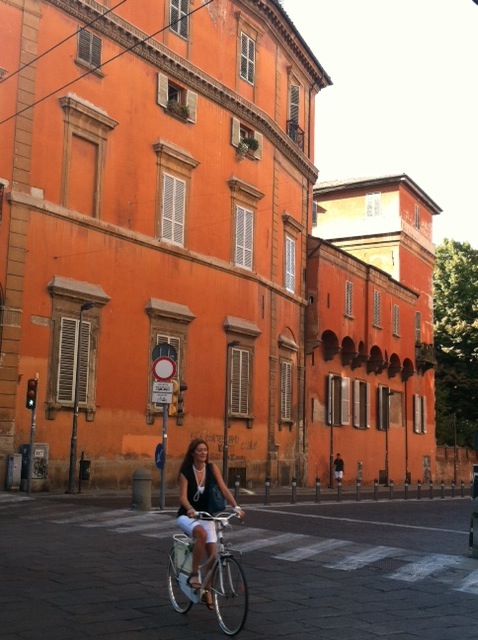
Bologna Orange on a building in the University neighborhood.

This morning it is gray outside. That’s unusual. Most mornings the sky is shockingly blue. In the evenings, just before sunset, the light shifts so that a copper shaft (probably a vent for the gas appliances) on the building opposite our balcony shimmers against the orange of the building. I have taken to standing on the balcony and checking for the light shift at the end of ever day.
The copper is beautiful to me in the evening light in part because it seems to concentrate all the colors of the city in its surface just before dark hides them until the next day: the rich oranges, audacious roses, mustards, and mossy greens of the buildings constructed in the Renaissance or later and the not-quite-red, not-quite-brown bricks of the older medieval buildings.
Periodically I try to capture the colors with my camera but I fail. The pictures don’t show how alive the walls of the palazzi are, how thrilling a big green pine is against the wall of a more-cheerful-than ochre school, how well the pinks and yellows complement each other, how they seem to conceal all of the uglier things in plain view, the trash bins and cars and the endless supply of street signs.

From chari to bici: The zen-free landscape of bikes in my life

24 Monday Sep 2012

Posted by wonderfuladventuretrip in bikes in Bologna

≈ 2 Comments

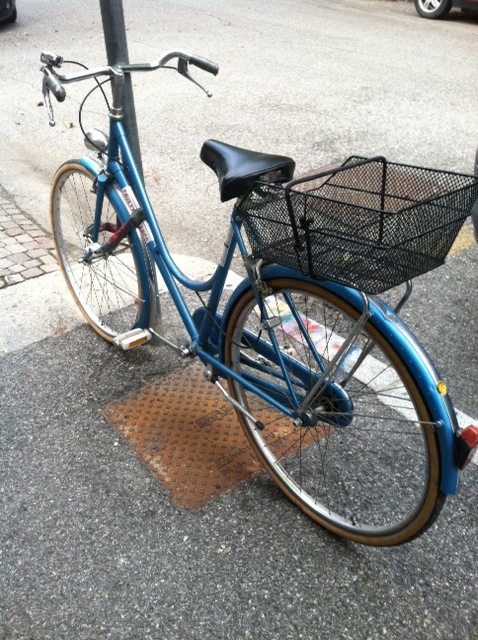
My infamous “city bike”

When, shortly after we arrived in Bologna, I uploaded few photos to my Facebook page, my friend Julia posted a comment about all the bicycles she saw in the picture. She thought it was a great sign about the city. So did I.

The first big writing project of my life had been a book titled Bicycle Citizens: The Political World of the Japanese Housewife. Cycling is both my sport and one of the most popular recreational activities in Italy, and Bologna is literally littered with bikes. I assumed from my first day here that my son, Tieran, and I would soon be whipping about town on commuter bikes and that, in my free time, I would be hitting the hills south of Bologna on a road bike that I was sure I would acquire used and cheaply from a local shop.

(Okay, so the free time thing is a total fantasy…)

But seriously. When I’m in Tokyo, I can always get my hands on a “chari,” a beat-up city bike. Usually a friend will loan me one from the family stash. But one year, when my son and I were planning to spend a semester in a Tokyo suburb, we got another friend to drive us to his favorite bike shop the day after we arrived.  In a few minutes, I bought two used bikes in sound condition that I sold back to the shop owner at a slight discount four months later when we returned to the States. Bike shops and new and used bikes are readily available in Tokyo. Quick adjustments to brakes or seats are usually free of charge, and air for tires is also free at most gas stations.

Bologna is not Tokyo.

But seriously. We arrived here in the brutal heat of early August to find the city shuttered for the rest of the month. I really couldn’t imagine where, under the miles of grey aluminum that covered store windows, a bike shop might be. The Bolognese had gone to the sea for the holidays and left behind them a city of immigrants. We rode the buses together looking at each other in a wary, sweaty way and speaking every language under the sun but Italian.

Finally, one evening toward the end of the month, while seeking out Tieran’s school, I saw a small bike shop, just closing up for the day. A few days later, Tieran and I set out on our hunt for used “bici” (beat-up city bikes). My shoulders clenched to hold up my still weak Italian, I marched into the shop and announced to the man there that we were hunting two used city bikes and that, also, because I was a serious cyclist, a road bike. Okay, first I apologized for my bad Italian and then, while the poor man shook his head muttering his doubts about the likelihood that we would be successful in communicating, I plunged into my list of needs. But at any rate, I’m sure I kept my shoulders up about my ears somewhere for the whole conversation because I was trying pretty hard to get it right.

I got it right enough because he laughed (yep, at me) when I told him I was a cyclist and then he told me they had no used bikes, that I could buy one of their new city bikes for 150 euro and that I could rent a road bike for 20 euro per day, or maybe less if I talked to the owner but that I would have to come back Monday morning for that. Ahhh. Bike shop masculinity. We have it in America, too.

I was miffed at the laughter, and since on the streets of Bologna I had not yet seen a bike as new as the city bikes he offered me, I was unwilling to accept that new bikes were my only option. I headed out onto the Internet. I discovered an organization/bike shop that described itself as the source of the  “social” bike (in English), which, in Italian, was explained as the commitment to recycle used bikes, to fight the black market in stolen bikes, and to put an affordable set of two wheels in the hands of every citizen. Okay. This was it.

I wrote a very polite Italian letter to the email address on the website, and I received a very polite reply suggesting I visit the shop personally where I might find used bikes and where new, red bikes would also be available for 80 euro each. The shop was in a suburb across town from us. We hopped a bus and made our way out there.

An older couple was embroiled in some sort of conflict with a lanky, bike-grease-gray man with a thinning ponytail and a girl’s green plastic headband to keep the hair off his forehead. After a bit of what seemed to be shouting, the woman marched out to the parking lot and returned with some object that she present to the grease-gray man. She scolded her husband. He bickered back and forth with bike-grease guy about dates, and then they left the bike for repairs and headed out. I hiked up my shoulders and prepared to make my case.

“We’re looking for used…”

“Used bikes? No, no, none here.” Bikeshop Gray gestured to the room full of old bikes, and I assumed they must be bikes left for repairs. “We have the new ones at 80 euro.”

“Just the new? We are only here for 10 months, and I was hoping to find used. Will you get…”

[As in Japanese, also in Italian one need never finish her sentence, although for different reasons.]

“At any rate a used bike would run you 50.”

“But 80 is more than 50. I don’t know, maybe I’ll have to think…”

Big shrug because, to a bike socialist what difference does 30 x 2 euro make, after all?

“Go ahead and think, okay, just you try…[he kept talking in an ever louder and more emphatic voice but I couldn’t understand it]”

I offered a quick thanks and headed out the door. The little red bikes were sitting on the pavement in front of the store. Tieran looked longingly at them. So did I. Pulled up my shoulders again and headed back in.

Bikeshop Gray was leaning over a bike another man (with a gentle, silent smile) was repairing.

“Signora.”

“I was wondering. If, when we have to return to America, we could sell them back to…”

“Sell them to me?! No, no, no, we don’t do that Signorna. Maybe in America you…[Bikeshop Gray leaned over the bike he was repairing and kept talking, seemingly unpleasantly but I couldn’t understand him.]

“Okay. Thank you.” Out the door we went again. I was shaking a little bit. It’s physically exhausting to keep one’s shoulders hunched when battling back the nerves caused by bike hunting in a foreign language.

We sat down on a little bench. I told Tieran the bikes were too expensive. Actually, they weren’t so much more than I had originally spent for the used bikes in Tokyo several years earlier. I mulled this over. We needed bikes. The buses were great to some locations, but Tieran’s school was not on a good bus line and at 2 kilometers, a bit far away for walking every morning.

I pulled up those tired shoulders one more time and tromped back into the store.

This time Bikeshop Gray was arguing with a customer who wanted to have the flat tire on his son’s bike patched. The valve was impossible. A new tire was imperative. No, it could not be done today, and not Monday either. Maybe Thursday. My Italian seemed to be improving by leaps and bounds. He sent the by-now-tentative father and son on their way.

“Signora.” This time with a note of exasperation even I could detect.

“I have thought [‘about it’ was really beyond my reach at that point]. We need bikes. We will buy the new red bikes.”

Bikeshop Gray chippered up and introduced himself as Jim (not his real name). He explained that I would have to come back on Tuesday because he didn’t have any ready at the moment. I didn’t have the wherewithal to ask about the ones sitting in front of the store. He gave me a card and wrote his phone number on it, and I gave him my name and number on a piece of paper. I told him that Tuesday didn’t work, that I’d be back Wednesday morning.

Wednesday morning I woke to a pounding rain. Before I was even out of bed the phone rang. Bikeshop Jim announced that the bikes were ready.

“Okay, good. But it’s raining this morning [and if I could, I’d tell you that I don’t want to cross the city on bikes in the rain with my 11-year-old son who cannot remember the last time he rode in traffic]. I’ll come on Thursday, tomorrow morning.”

“Thursday?!! Signora! Thursday there is a festa! [Party? Sometimes in efforts to clarify things for those who don’t speak our language well, we speak to them as if they are toddlers, thus making things even less clear for them.]

“But I can’t come today. I’ll come Thursday, tomorrow morning [What festa? A party on Thursday morning?]”

“Thursday?!! Signora!! Blah, blah, blah, blah.”

“It’s not good? Is tomorrow morning not good? When is good?”

“Tomorrow blah blah blah [louder this time].”

“Okay, then, I will see you tomorrow morning.”

“Signora!! Basta (enough) !!” [In class I hadn’t learned that  “basta” was a way to end a phone call…]

Thursday morning, Tieran and I got up early and took the bus across town again. The bike shop was closed because, as the sign said, it is always closed on Thursday mornings. Ahhh- the “festa,” the day the shop is regularly  “chiuso” (closed). Not a party. Closed. Damnit. Basta.

We got back on the bus and headed to Italian class. After Italian class, we joined a group from the school for a tour of a local church. On the way to the church, the phone rang.

Bikeshop Jim. “Signora.” With the low, growly tone of absolute, unmistakable irritation.

“Si?”

“Are you coming to the bike shop?”

“I went this morning. It was closed.”

“It is closed on Thursday morning but I’m here now. Are you coming now?” A definite bullying tone of rising anger. He could have been at the festa, after all.

“I can’t come now.”

Some shouting.

“Signore!”

He actually pauses.

“I know I’m not Italian and I don’t speak good Italian…”

Shouting.

“Listen!”

Shouting.

“Listen!”

A pause.

“I know I don’t speak good Italian, but I am trying. You have to have patience.”

“I am patient!! [more shouting] Basta!!” He hung up the phone in a complete and final demonstration of his patience. Goodbye Bikeshop Jim.

I did get bikes about a week later – two lovely clunkers from a friend’s apartment garden. Her father collects old bikes and repairs them. When she got home frome the seaside and realized I just wanted plain, old used city bikes she told me to come right over and get them but to buy a big lock on the way home. The theft of used bikes is the most common crime in Bologna. No wonder.

Then Sam, my boyfriend (companion, partner, friend, neighbor, whatever he is, but not his real name as he does not want a presence on FB or in the blogosphere) who is visiting needed a bike. Turns out that the first bike shop that doesn’t ever have used bikes suddenly had three used bikes for sale, including a smaller mountain bike we bought for Tieran so that Sam-not-his-real-name-friend-neighbor-boyfriend could use the bigger of the two older bikes.

Everything was then settled because at the apartment we also have a back “garden” (very large gravel patch rimmed by trees) at the building where my landlord told me we could put bikes.

Then the first afternoon I tried to park my bike in the back garden area, an older gentleman leaned out over his balcony on the far side of the building.

“Signora!!!Why are you parking your bike there?”

“My bike, uhh?”

His question was both hard to hear from such a distance and hard to answer, given that it seemed somehow to make sense only as a fundamental ontological question, demanding a level of Italian I just don’t have yet.

Luckily, in keeping with Japanese/Italian tradition, this man did me the favor of continuing on regardless of my incomplete response.

“Signora this is a garden. I have been tending it for twenty years. You may put some lovely flowers in the garden or a plant, but you may not park your bike there. This is not a parking lot.”

“Yes, it’s a lovely garden,” I agreed, hoping to smooth over the issues and looking about seeking something on which to focus my attention other than the gravel and an unused plastic table. Perhaps, in a Kyoto temple the gravel might be the base of a suiseki, water-and-stone, zen landscape but here it was just gravel. On the old man’s end of the space he had placed a handful of plants in pots.

“It is not lovely. It’s ugly because people are using it to park things.” He gestured toward another bicycle and a moto in a dark corner of gravel nearly as far from his window as could be possible.

“If you park your bike there, I will call the authorities. I will haul you in front of the courts.” It seemed a rather sudden escalation of the situation.

“I think you should introduce yourself before shouting at me like this.”

“Signora, you are the one shouting.”

Back and forth this went including my (in terms of language skill) triumph of a question “Who are you in relation to this garden? Are you the dean of the garden?”

Eventually, while he shouted, I wheeled the bike under his balcony, in the back door of the basement and into the dark hallway for the little storage units (the cantinas) for the apartments. Fumbling for a light switch, I dropped the heavy, old bike. I swore.

Then, suddenly, a light came on. A neighbor I had not yet met had come down to tell me to ignore the “pazzo” old man, that the “garden” could be used to park bici and moto, that she had been formally guaranteed by the condominium manager that she could park her moto there.  She apologized that I should have been treated in such a manner by another building resident. I shook the neighbor’s hand and introduced myself. For the time being too sore about the neck and shoulders to go back out to the “garden,” I put the bike into the cantina.

Upstairs Tieran, who had apparently watched the whole scene from our balcony, was waiting for me at the apartment door. “That’s the best Italian you’ve spoken yet, Mommy,” he said with obvious pride.

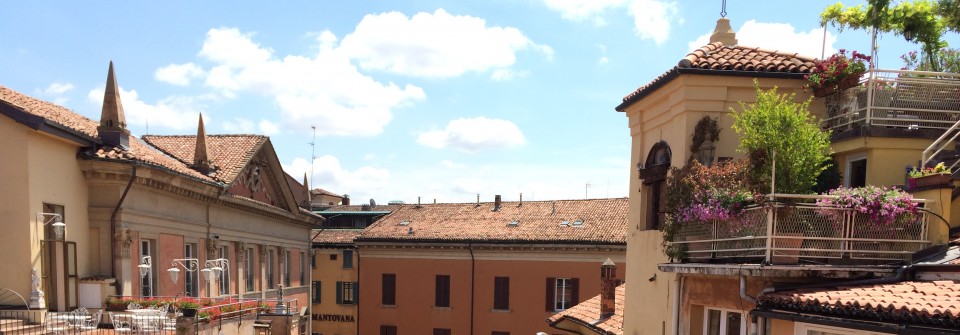
On afternoons and weekends, we ride our bikes down the cobblestone streets and across Piazza Maggiore (in the header photo). On weekday mornings, we get him to school more or less safely. We go to the parks and along gloomy medieval passageways and to the grocery stores. In my basket the water bottles and cheese and salami are not heavy. We slide along past the traffic, past the packed buses. I am a child again, full of joy with every turn of the pedals.

When we’re home, we store the bikes just inside the “garden” gate, at the side of the apartment building among some broken paving tiles beside a weed-covered fence. The old man would have to come downstairs and leave the building and come all the way around it to see how much they wreck the gravel landscaping. A few days later, a second moto appears, parked most evenings by the other in the back corner of the garden.

On Saturday morning, as I’m finishing my shower I hear a great commotion from the street below our apartment, angry sounds that seem to be made louder by the surrounding brick walls and then a big banging of the metal gate on the garden fence. When I’m dressed, I find my son at the living room window all excited. “It was the old man,” Tieran says. “He was shouting at a young guy with a moto! The young guy shouted back, a lot.” Tieran relishes the drama. I worry about what I’ve started.

Bicycle citizenship. So much I didn’t know.

Recent Posts

  • So. I’m back.
  • How to blow out your bike tire in Bologna
  • Everywhere you go you take the salad (and, yep, the weather) with you
  • Seizing the cheese (this one’s for Meg!)
  • Under the Bolognese rains…

Archives

  • October 2020
  • July 2014
  • May 2013
  • March 2013
  • January 2013
  • November 2012
  • October 2012
  • September 2012

Categories

  • bikes in Bologna
  • food in Italy
  • motherhood
  • school in Italy
  • travel in Germany
  • travel in Tuscany

Meta

  • Create account
  • Log in
  • Entries feed
  • Comments feed
  • WordPress.com

Create a free website or blog at WordPress.com.

Privacy & Cookies: This site uses cookies. By continuing to use this website, you agree to their use.
To find out more, including how to control cookies, see here: Cookie Policy
  • Subscribe Subscribed
    • wonderfuladventuretrip
    • Already have a WordPress.com account? Log in now.
    • wonderfuladventuretrip
    • Subscribe Subscribed
    • Sign up
    • Log in
    • Report this content
    • View site in Reader
    • Manage subscriptions
    • Collapse this bar
 

Loading Comments...