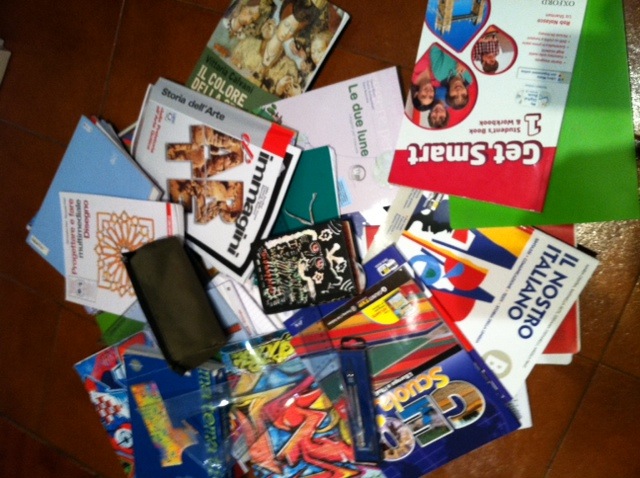
Some of Tieran’s books.
When we arrived in Bologna, the date on which school started, September 17, seemed to be known to everyone we met, regardless of whether the person had children in school or not, the same way in the U.S. the date of Christmas is known to Christians and non-Christians alike as an inescapable social fact. Everyone wanted to know immediately where Tieran was going to school, and he was offered congratulations and best wishes on the new school year from neighbors and vegetable vendors and gelato shop owners, just as if he were, indeed, about to celebrate a major holiday.
However, no one seemed to know what time school started on September 17, not even the parents of children in the same school. I called the Italian mother who had helped to introduce me to the school superintendent in June when I was trying to get Tieran a place. She called her friends, other mothers of other sixth graders. They didn’t know either.
A few days before school started, an announcement was placed on the school web site. The sixth-graders, in the first class of middle school, were to be at school by 8:00 a.m. The older students would start an hour later. The hour at which school ended was still unclear.
On the morning of the first day the members of the first class of middle school (scuola media) and their parents gathered in a sort of auditorium area near the entrance of the school where the new students were to be welcomed by one of the school administrators. She started off right away by telling us what time school was to end each day that week and how the days would be stretched out to the full schedule over the coming weeks. Then someone stopped her. She had told us the wrong times.
“I have made a mistake,” she said, and for a moment chaos threatened. Sensing an ebb in the power of the presiding authority, the children began to talk amongst themselves. Frantic to know if their children were coming out the door that afternoon at noon or 12:45 or 1:30 the parents started shouting out questions all at once. And then, somehow, things were calmed. She gave us the right time, explained that school lunch (which every day comes at the end of all of the classes at 1:30) would not start until the first of October. Some of us parents might have changed our thinking about whether or not to sign up our children, she explained. We had time to reconsider. A full two weeks before the school day would be extended until at least 2:30.
Then the first period teachers for the various classes stood up one by one and called from the crowd the children on their rolls. As each class was assembled, it marched off, up out of the assembly area and then up another open staircase to the classrooms on the second floor. And for each class the crowd of parents broke into energetic applause. Our small warriors sent off to their new frontier.
That afternoon Tieran came how with a handwritten list of school supplies the teachers had instructed the students to buy. At the office supply store nearby we dropped 130 euro in a few minutes. Tieran had done a good job of getting the list, and the supply stores know the game. The only serious confusion was when he tried to buy a “vergola.” He had heard the teacher read it out and copied it down perfectly. But a “vergola,” a comma, as it turns out, is a gratis tool for grammar class not proffered at the office supply shop.
The fact that punctuation can be used free of charge is no small favor, really. Once we had bought Tieran’s books, 250 euro, a small keyboard for music class, 100 euro, an art portfolio and special colored pencils, 50 euro, some extra notebooks, tools for technical drawing…we had surpassed a level of expenditure that even now I cannot face without a Tums.
But the art books. In the U.S. we don’t see books like these at use in grade schools. Tieran now has a glossy, gorgeous art history with removable folios of famous paintings, sculpture, and architecture from around the world that could be, as the teacher suggested, used for planning vacations and another book about “graphic theory” in which a car color is compared with Van Gogh’s sunflowers, the lines in a Cezanne painting are abstracted in a demonstration of the principles of composition and the greens in a Rothko and a Gaugin are place beside each other, provocatively the same.
Or then there are the music books, which teach more than how to read notes or “appreciate” a symphony piece but also start students on the basics of music theory. The history text is, itself, a gorgeous art history, among other things. The math book, which starts with numbers theory in a serious academic tone—“We remember the fundamental principle of addition as…”—perplexes us, and the English text, with brief British dialogues about iPods, entertains us. The Spanish book, written for Italians whose native language is so similar to Spanish, moves students along at a no-nonsense-let’s-get-talking pace. The book for technology and technical drawing digs into the relationship between materials and design. Geography is, of course, presented as the rich discipline it is, not simply as the study of regional borders and capitals. There are stacks of books for Italian grammar and literature. I try not to look at them too often because they highlight too fully my own linguistic inadequacies. Yes, there is a gym class, for which students must keep a notebook in which they write down fundamental principles of the sports they practice. The first fieldtrip was to a nearby branch of Bologna’s excellent public library system.
Homework here is legendary, and simply transporting the texts to school is a real athletic feat. But I feel like Tieran is getting a proper education. He is not merely being shepherded through a list of disconnected and simplistic “student learning objectives” in preparation for a test whose results are always more revealing of the economic wellbeing of the student body’s parents than the state of students’ minds.
When the Bologna teachers presented their “objectives” to us at the parents’ meeting at the beginning of the term, they were talking about complex intellectual aims, talking with the voices and with the confidence of well-educated and respected professionals. Here teachers are called “Prof.” Somehow they do not think squirmy, noisy middle school boys (in Tieran’s class there are 20 boys and only eight girls) are exempt from a well-rounded, intelligent study of their world. In the United States we save that approach to learning for the kids whose parents can afford a liberal arts college education, like the one through which, probably too late in my students’ process of mental development, I try to encourage an appreciation of the subtlety and complexity that is not welcomed by the “back to the basics” politics imposed on the embattled American public schools and disrespected American teachers.
Teachers in Italy are empowered in other ways as well, some of which would never be tolerated in the United States. No student’s learning is a private affair. When a child who hates writing turns in a three-sentence essay for the Italian literature teacher, his work is publicly compared unfavorably to the much longer essay written by the American who is just learning the language. Teachers and students alike try to get my quiet son to practice yelling in the classroom; they think he needs it. When a student cheated off the Internet and “wasn’t even clever about it,” the indignant teacher projected the Internet source on a screen for the whole class to see while she revealed the cheater’s identity and read aloud the copied paper.
Because I am a teacher too, I am exhilarated by the fierceness of the Profs and by the richness of their ambitions for the children. But school also threatens constant chaos. For me, school in our life here is like a huge, barely disciplined but loveable dog. It eats into my finances and threatens, at times, to swallow my son whole.
Every day the schedule is different. Some days Tieran gets out at 2:30 after eating a plate of prosciutto and a slice of pizza or tagliatelle with ragu at the school lunch. Other days he has to stay until 4:30 for a post-lunch session about study skills which, as he points out, takes up a lot of time in which he could be doing homework. School takes up every more space in our home routine. One Sunday we spent three hours trying to figure out what a math exercise was about. The organization of social life among children or parents is only partly comprehensible to us. We know Tieran has basketball games starting next weekend, but we don’t know what day or time or location. We don’t even know how to find out. Everything seems suddenly busy, busy, busy.
The school helpfully sends home many memos explaining everything from the parent’s council elections, to teachers’ strikes to opportunities to participate in voluntary after-school activities. I know all of the words in Italian. But still their meaning eludes me.
In accordance with the norm established by and in article 2, of the O.M., number 215 of the 15.07.1991, for the days 11 and 12 of the month of November, elections will be held for the constitution of the institutional council that will be obligated for the tenure of the three years 2012/2013 – 2013/2014 – 2014/2015, in the sense of the tenth subsection of article 8 of the D.L.vo, number 297/94…
OR
In the sense of and for the effecting of the deliberations of the Governing Council of the Region Emilia-Romagna number 775/2004 – published on 01/09/2004 in article number 1, letter a) e c) of the D.M. 28 February 1983 and thereby attached as “H” of the D.P.R. 272 of the 28.07.2000, the release/revision of the “booklet of sport health” is requested in accordance with the cited D.M. for the practice of non-combat sport activities for the student coming under health examination for participation in…
Who writes these memos? Am I supposed to be reading them or have I been mistakenly sent a copy of internal correspondence from the counsel’s office of the Bologna school system? Am I supposed to be at the aforementioned meeting held in conformity with regional regulations and national laws? Do we really need a “booklet of sport health” released/revised by an Italian doctor (whom we don’t have)? Is it really possible that the other parents understand this stuff?
When the teachers do strike (twice so far because big cuts to the school budget are planned as part of Italy’s austerity regime), they don’t do it all in unison. Parents are “invited” to come to school on the day of the declared strike to find out if a student’s first-period teacher is striking or not. If she or he is striking, then the student has no school. If, however, the particular teacher is not striking, the student will have some sort of school – math class followed by videos then gym, for example.
Last week, as part of a general strike across Europe, some of the middle school teachers struck.
We had to got to the school on the morning of the strike because Tieran’s first period teacher – who did strike earlier in the fall- had told them the afternoon before that she didn’t know if she would strike or not. The students crowded up to the school doors waiting to see if they would have to go in when school began at 8:00.
Outside the gates, lots of parents waited to find out if their children were staying or not. The school called kids in by class while the parents groused among each other that it was crazy not to know until the last minute if their had school.
Moms were standing on tippy-toe trying to see if their kids had gone in when one courageous mom who had gone as far as the school door (where middle school children do not like their shameful progenitors to be seen) came out the gate pumping her fist. Her daughter had been taken in to class. “Ho vinto!” she said (I won!). Meanwhile the last of the classes were collected and a group of students was left outside the building. They began to cheer, realizing they would have no school, and the parents who still remained at the gate, thinking their kids were probably in that group, looked crestfallen
Tieran and I had made a plan. If his teacher showed up he would send me a text with her name. I got T’s message, “Bozza,” and I headed off to Colonna Bar for my morning coffee and croissant.
I could barely see the street as I came up toward Colonna Bar on the bike path beside the high school, which is directly across the street from the coffee bar. Students were spilling out into the road even more than they usually do before the start of classes. At first I thought it was that they, too, were waiting to find out if their teachers were striking or not – and maybe that was, in fact, part of the confusion. But they were also being organized by a classmate – a young brave guy holding a megaphone and standing in the middle of the rush hour traffic moving down on the Colonna side of the road. He was talking about speaking up for the future, about how Italy could not go on with this “politica” and some other things about schools and workers hard to hear over revving moto engines and the chattering students. Buses struggled to get through the intersection, cars honked as they tried to get around the protestors.
Finally (maybe about 8:15), he and others led the group off, down the middle of the road, behind banners made on sheets, heading toward Piazza Maggiore in the very heart of Bologna, where, the newspaper reported later, students filled the Centro – 10,000, forcing the police to barricade themselves at their headquarters and throwing eggs at Carabinieri (a force like the police but different). But also, the paper reported, there were musical performances and open classrooms in the piazzas.
Last week I had a fascinating interview with a Left-leaning member of the Bologna city council. For him, the problem of declining school budgets is a very serious one, especially as Bologna faces a future with an ever more diverse population, one that is ever more stressed by economic crisis. This year some parents were turned away by public preschools that were out of space for students. This politician is part of a group of citizens that wants to bring about a referendum demanding that all public schools will be fully funded before any money will be shared with the parochial schools that have traditionally received some. Our public schools have been good, he told me, especially here in Bologna. They are the only place where people of every generation and from all the different communities of our changing city have to spend the day together. They are our future.
Ours, too, I think. We Americans will also have to struggle for this future. But I worry about our already stripped-down American starting place. And where, I wonder are our striking teachers, our marching students, our public-square classes?
 wonderfuladventuretrip
Your school adventures remind me a friend’s travel story: Two friends were traveling on an Air Italia flight from the US to Rome and mid-flight there was a general strike; fortunately, the pilots landed the plane in Rome, but they did not pull up to the gate; instead, the plane remained on the tarmac; the crew released the inflatable, emergency shutes and slide down leaving all of the passengers to fend for themselves, get down the slides, and unlock the hold an retrieve their luggage. Upon entering the airport, even immigration was striking so there were no passport checks and everyone entered the country this way. Viva l’Italia!