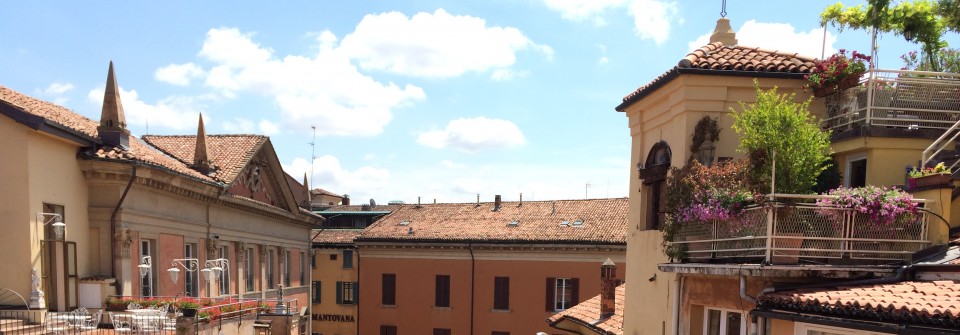
So, the rain has eased but it hasn’t stopped. We still get some rain here in Bologna almost every day. Today I read in the newspaper that this winter we got something like 200 percent of the average rainfall. All the weather predictions suggest lots of rain at least until June. But we are also getting a lot more sun, and it’s a lot a warmer. At one point in mid April, we had seven or eight sunny days in a row! Now, in mid May those days seem like a distant dream. Still, they were real enough that I dug to the back of the closet for a pair of sandals that I actually wore for two days in a row, real enough that bars and restaurants put their tables out on the street again, and real enough to remind me how beautiful Italy can be and what a privilege it is to be here.
In the midst of all the giddiness caused by the glorious arrival of spring, I kept a good head on my shoulders and discipline in my heart. Both of which I used to seize the cheese, I mean, the day. Or, no, actually, I mean the cheese.
During the soggy winter months, Cyndy an American friend here and a frequent companion for meals and coffees, had regaled me with descriptions of her favorite luncheon adventure. Finally, one sunny afternoon, after a mind-melting two-hour session talking to micro-credit and public housing specialists, an architect and an engineer, all trying to reinvent municipal policies to build a new culture for the future in the midst of a government spending crisis, I took her up on it. We jumped the high-speed Frecciarossa (Red Arrow) train for the 37-minute ride from Bologna’s central station to the historic center of Florence and a lunch extravaganza that, in itself, should have qualified me for a lifetime membership in the bourgeoisie, despite my working-class roots.
I should just take a moment here to say that a popular cause among young Leftists is opposition to high-speed trains, expressed often in stickers and graffiti that reads “No TAV,” or spelled out, “no treno ad alta velocità,” no trains at high velocity. Opponents of a new high-velocity line that is planned to connect Torino and Lyon argue that building the line is a poor use of public funds, that there is little demand from passengers for the line, and that its construction is unnecessarily damaging to the environment. A few days ago, the movement took a violent turn, with some of its adherents launching Molotov cocktails at one of the line’s worksites.
In leftie Bologna “No TAV” signs are everywhere. Once, when I was trying to explain the commonalities between the situation of the youth in Italy and Japan to a Bolognese guy in his thirties, he asked me if the young Japanese also opposed high-speed trains. I was dumbfounded. Maybe there are some stealth anti-bullet train groups I don’t know about among young Japanese. I, however, am such a product of the ideologies prevalent during my own youthful days in early 1990s Tokyo that I am embarrassed to say it had never occurred to me to have anything other than slave-like admiration for high-speed trains.
Now, I say all this because, as I slid seamlessly from a discussion of Bologna’s housing crisis with local policymakers to a cappuccino served in a real china cup in the “Red Arrow” train bar to a seat before a pre-lunch truffle sandwich at Procacci, another bar on a nice little Florentine street, I did start to have the nagging suspicion that maybe I actually understood what was socially bad, bad, bad about the TAV, and that, maybe, it was me!
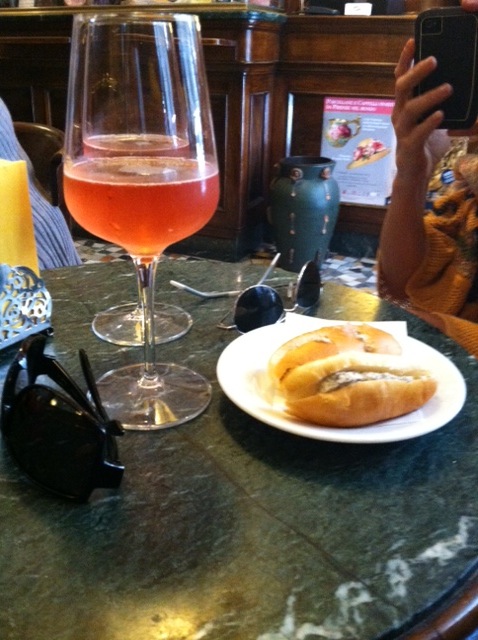 Pre-lunch truffle sandwich, you say? Ah, yes. This is the beauty of Cyndy’s empower-yourself-lunch (my name for her intellectual property).
After we devoured out little funky, rich bits of bread and truffle, we headed to Cantinetta Antinori, a restaurant in the 15th century Villa Antinori, the original home of the great Antinori winery family. Because Cyndy has cred there, we were greeted with little glasses of a wonderful moscato, a welcome refresher after our long journey from the truffle bar on the other side of the street.
Cantinetta Antinori has a huge wine list, including an amazing selection of wines by the glass. The food is simple, seasonal Tuscan cuisine. We started with two appetizers, a plate of mushrooms,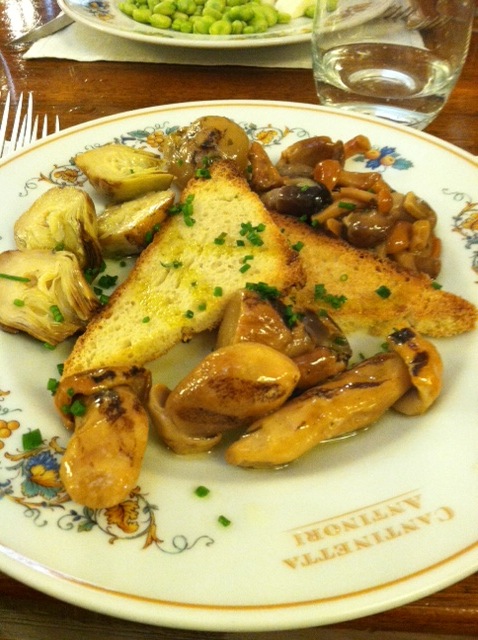 and a plate of fresh pecorino (sheep milk’s cheese) and fave (the beans that come in spring in the huge, long pods, not always easy to find in the US but ubiquitous here), and glasses of white wine, in my case, a Vermentino.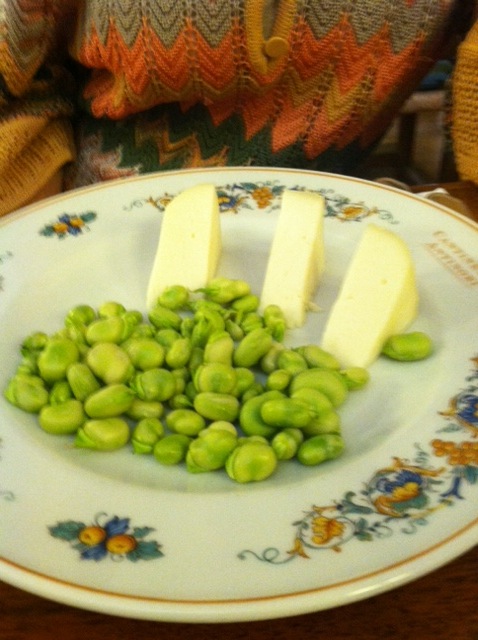
This we followed with an unexpected combination of mussels and cannellini that we consumed with red. We ordered different wines in order to be able to taste more varieties. Cyndy had a glass of Tignanello. (And yes, Ross, this one was ready and AMAZING!) I had a glass of Pian delle Vigne Brunello di Montalcino, rich and delicious. Finally, we finished with a plate of three varieties of aged pecorino, these served with chianti, for me a surprising and fabulous combination.
Eventually, we sort of melted out of the restaurant and onto the streets of Florence where we managed the short walk to the Piazza Duomo, took in the masses of tourists with boozy shudders and headed for the train back to Bologna. I landed on the station platform feeling a bit vague but decidedly more important and enabled than I had felt for all of the rainy winter months. I dragged my beat-up bike from among the other rusty-and-trusties locked to poles and fences around the station entrance and pedaled home to arrive only a half hour or so after Tieran had finished volleyball practice.
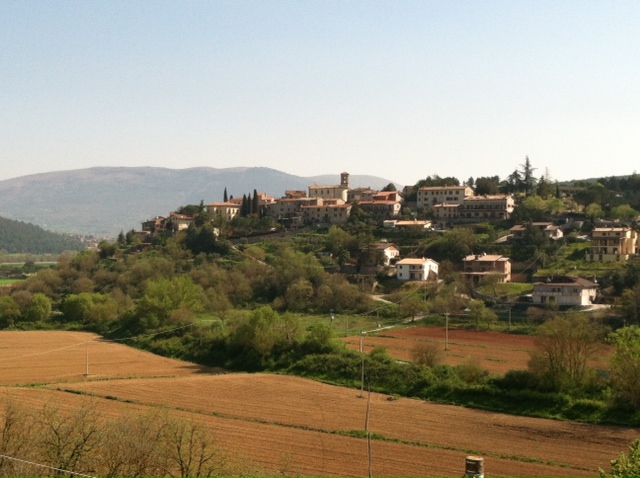
Hill town from window of Umbrian villa.
Then a continuation of the celebration of the arrival of spring, the next weekend Tieran and I headed to Corciano (near Perugia) in Umbria. Here we met up with our friends Kathleen and Dusan who are leading a group of students through Italy for a spring term painting class. After flat Bologna of the great Padana plain, my mountain goat self was thrilled to be up in the medieval hill towns of Umbria and Tuscany. The students in Kathleen’s class have the great good fortune of spending weeks (interspersed with unbearable trips to Florence, Venice, Rome…) in a rambling, old villa that specializes in hosting educational groups. The villa allowed Tieran and me to rent a room for a night—spare furnishings, questionable (no, bad) mattress, high ceilings with old beams and a window that looked out across a broad valley of a multitude of greens at another castle town on a hill. I could have easily imagined staying there with that bad mattress forever.
But, we had work to do. We drove past fields flowering in heart-searing yellow, along Lake Trasimeno and into eastern Tuscany where we climbed up into the town of Montepulciano to taste the area’s famous red, Vino Nobile di Montepulciano. The wine tasting was great, of course, but so, too, were the little snacks served with it, tiny toasts with chopped mushrooms, bits of Tuscan salami with fennel, and more pecorino, including two I absolutely loved, one aged in a coating of ash and the other in a coating of dried hot peppers.
For lunch, we went on to Pienza, a town known mostly for the pecorino produced by farms that surround it. We chose a restaurant with a big outside dining area on the end of a sort of cliff, from which we looked down at a narrow road winding through the yellows, the intense new grass-greens of the fields, and the gray-green of olive trees. We have eaten dinner in Lexington at Kathleen’s house under her paintings of landscapes like this, and so we were unexpectedly and gloriously at home in our wandering.
After our exciting tasting of Vino Nobile di Montepulciano in the morning, we ended up ordering a Morellino di Scansano for lunch that disappointed us. BUT a plate of various pecorinos that ranged from the almost naïve, slightly sharp fresh cheese to the funky super-aged, served with deep and dark and mysterious walnut honey made up for the wine mistake.
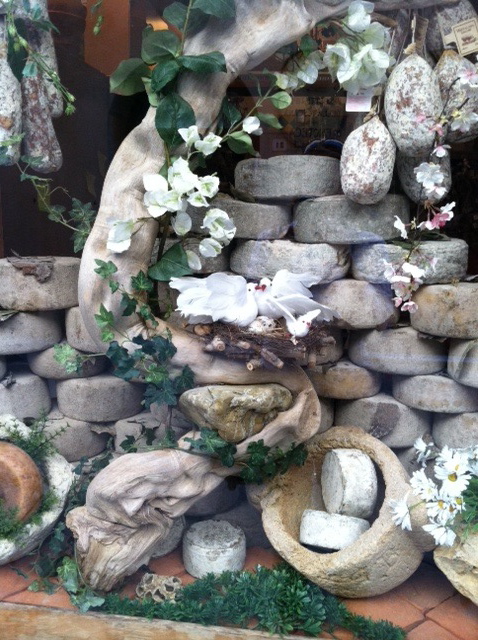
Pecorino aged in ash
As we dropped back down the hillsides toward the lake, we stopped at a farm that sells its pecorino directly to visitors. Tieran and I filled our backpack with several varieties, including a precious fresh one that we transported between various refrigerators before we got back home to our Bologna apartment. We also got a jar of the walnut honey. Tieran said it’s flavor is so strong that it’s almost impossible to eat without cheese. We ate dinner in Cortona, a sizeable town perched up on such a steep hillside that it seems, frankly impossible, like the sort of thing only Dr. Seuss would have envisioned. And yet, there it was.
The next morning, before we went home, we drove into Perugia and took the “Mini Metro” from the modern, industrialized valley where the main station is up to the very top of the hill on which the historic center was built. The Mini Metro is an automated monorail, a cross between a ski slope gondola and something you might expect to see traveling between concourses in an airport. But in Perugia this gondola-airport shuttle does not deliver you to an overcrowded departure gate and the naggy, scoldy PA system warnings and exhortations of contemporary airline travel but rather up a roller-coaster worthy rise to its last stop just under a peaceful café bar with stunning views. As my friend Dusan said, there is something about the ride that resembles a science fiction movie, especially at one point in which, as the train heads into the steel-lined mouth of a hypermodern tunnel, you see rising above you the medieval heart of Perugia as if it was stopped in time centuries ago.
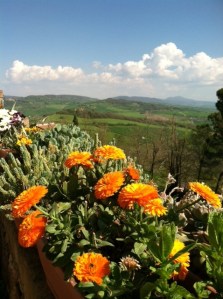
From Pienza
When we got back to Bologna, it was raining. Of course.
Over the last few weeks, we have consumed all but one small piece of the pecorino. We have had some truly beautiful days in which the Bologna-orange buildings absolutely glow against an intense blue sky, and we have had a good share of others, like today, in which rains falls off and on and the sun struggles desperately to burn a hole in the cloud cover.
The Bolognese complaints about bad weather, now that it isn’t bad as often, have grown fiercer. Yesterday morning, after I walked Tieran to the bus stop in a cold drizzle, I stopped in at my regular café bar for breakfast. The matriarch-barrista and her friends were up in arms about the “stagionale malattia” (seasonal illness) the cold and wet were bringing on. After breakfast, I went to the butcher, who had seen me return with a red face from a research visit to a communal vegetable garden on a sunny afternoon earlier in the week. He assured me grimly, as he prepared my steaks, that there would be no danger to my skin in this weather.
Before I took the steaks home, I went on to the newsstand where the owner greeted me by throwing his hand out in the direction of the sky and saying something about ugly wolves. “What?” I asked. “This weather,” he said. “What can you do with weather like this?” He tossed his arms and hands up in the gesture of one who is disgusted with the world at large.
Knowing I wouldn’t be doing a morning bike ride, I went home and sat down at my computer to expand on some notes taken on my garden visit, but the school called. Tieran was feeling bad, and I needed to come get him. I wondered, had he been hit by the dreaded “seasonal malady”?
I waited on the wet sidewalk in front of our apartment building for a taxi to take me to the school. The elderly neighbor who last fall had sided with the resident crazy about the bicycles in the gravel “garden” and had then insisted I switch mailboxes with her to correct a twenty-year-old error came walking toward our building with a grim face. I girded myself.
“Can you believe this weather?” she asked as she put her key in the entrance lock. “It’s as if we have turned back from spring!” “Really is!” I agreed. Then sweetly, as one good neighbor might for another, she asked me if she could hold the door for me. I told her I was waiting for the taxi and stood there as she went in, a bit shocked by her unexpected gentility. Maybe she has a seasonal malady, too, I thought.
Turned out my son was not in the grips of a dangerous seasonal illness but more simply rundown and in need of a break from classes and access to a bathroom with toilet paper and soap. Both disappeared from Bologna schools when big cuts were made in education funds under the stability pact the national government made with Ms. Merkel–and okay, a few others, as well. The local government might have saved the toilet paper and cut back further on support for instruction. But that’s now how labor politics OR education politics work here. My son might have brought the tissues and hand sanitizer I had bought him to school in his backpack, but that sort of preparedness is not his forte. Anyway, after an hour or two at home, Tieran was right as the rain that continued to fall.
Satisfied that my son was not in an health immediate crisis, I decided to make good on my appointment with a University of Bologna sociologist who had promised to show me a more “militant” side of urban gardening than I had seen at the beginning of the week among the city-sponsored vegetable plots assigned largely to pensioners. I met the professor north of the city center in a historic “worker” (we would say “blue collar”) neighborhood that was pulsing with life. The garden was attached to a student-dominated, radical left “centro sociale” that has, as have a number of other locations like it, become the sponsor of a weekly organic farmer’s market.
I ignored the awesome-looking organic wheat beer, the slices of thick focaccia with roasted zucchini on top, the lovely lettuces and all of the homemade preserves for sale at the market as I walked through on my way to the garden. I took due note of the big, fascist-looking, black and red antifascism posters, of the asymmetrical haircuts, the enormous range of piercing styles, the advertisements for an Italian language school for migrant workers and free yoga classes offered in a “people’s gym,” and the truly compelling murals painted in amongst the quotidian sloppy graffiti on the sheet-metal of the abandoned warehouse that now served as this social center.
I nodded in agreement while one of the project’s leaders explained to me that the garden served perhaps more as a lovely impromptu piazza than as a source of vegetal sustenance. I checked out some Armani eyeglass frames one activist was wearing and wondered idly how many hundreds of euros the hippy-style, wrap up the ankle, soft, orange leather shoes worn by one of the socially-concerned garden market customers cost. I sympathized with the activist’s description of Italian politics as not doing things she though of as “interesting.”
I liked the alternative rock playing in the background, the groups of people, seated on old chairs around planters made out of tires and bathroom sinks, talking and laughing over tiny glasses of organic red wine, and the earnest young men gathering sage from a garden container for the “social(ist) dinner” they were preparing in the building next door. “It’s too bad the weather is like this,” my professor-friend-guide said, pointing a cigarette up toward the sky. “Normally, this place would be full of people on a Thursday night.”
To me, it actually seemed pretty lively, but the project leader (who does not think of herself as a leader, but more as a co-worker in a new social reality) agreed with the professor. “Last Thursday it was absolutely full,” she said, “but with the rain…” She shook her head in disappointment at being unable to give me a real sense of the community value of the space.
On the way out, I couldn’t help myself. I had to stop at the mercato for cheese. There was a farmer from the area outside Bologna standing by a vendor cart with a refrigerated display case of his beautiful goat cheeses. They were calling for me. First, I picked out a blue one, one that looks almost like a blu di bufalo, a perhaps more widely know Italian cheese made not from goat’s milk but from water buffalo milk.
Then I saw it. A round about as big across as the palm of my hand with an orangeish rind dusted in a blue mold.
“What is that?” I asked. He didn’t give me a name. Instead, he sliced the round in half and gave me a little piece from its center to try. The cheese was almost dryish, almost crumbly inside, and it was ripe to the very, very last edge of the moment before it would begin to have that ammoniac odor that would ruin it. But it wasn’t ruined yet. Oh no, far from it. In my mouth, the super-white dryish interior of the cheese melted into something insanely smooth and creamy while the moldy rind added a piquancy (sorry for this word, but it’s the only one that will do) and also, of all things, a finishing sweetness. The flavors lingered in my mouth long after I swallowed, improving, unfolding, just as the best red wine will linger. It was one of the most extraordinary bites of cheese I have ever had in my life.
“Buonissimo, incredibile, perfetto, non ci credo!” I tossed out every Italian superlative I could drag out of my cheese-drunk mind. The thirty-something farmer shook his head. “It’s just too bad that most Italians don’t understand cheese,” he said. “Well,” I said, “it’s not like I could say that most Americans understand it either.” But I thought also of our Lexington, Virginia, Meg. I wished she could have been with me.
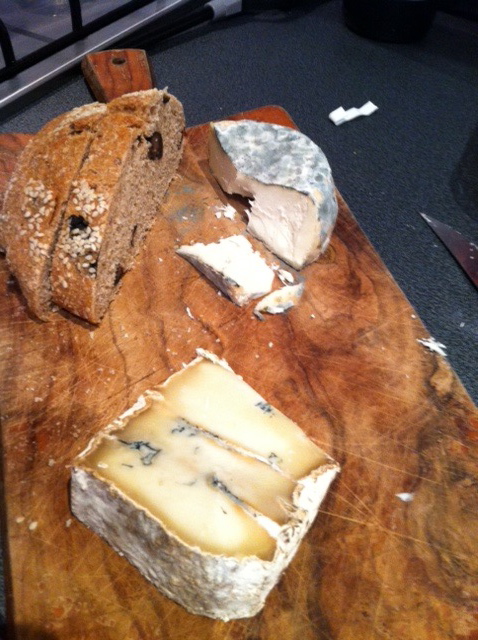
Bologna goat cheese
The young farmer smiled and offered me an empathetic shrug. He wrapped up half of the mystery cheese round and added it to the blue in my bag. Joyously, I headed home. I was two blocks down the street, well past a halal butcher packed with African customers, a restaurant named simply Kosovo Balkan, and a Caribbean bar, before I remembered I had not asked the cheesemaker either his name or the name of his insane little round of goat’s milk and mold.
A tiny bit of sun peeked out from between the charcoal colored clouds, not enough to give me hope for better weather on the next day, but enough to make me feel blessed by the gods, the gods of cheese, the gods of those messy, delicious pieces of urban landscapes that defy “good planning,” the gods of young people who are “not interested” in currency crises and stability pacts but only the importance of humanizing conviviality among a bit green, and the gods that bring the participant-observer researcher back up whenever she starts to slide down.
I called Tieran and told him I was on my way home. He was cheerful and hungry. I jumped on the bus headed through to town’s center to my bourgeois neighborhood on the other side, the kind of place where you know at least a few people snack on truffle sandwiches. The bus was horribly packed, a little smelly, and incredibly noisy. It lumbered along from stop to stop, in absolutely no danger of reaching a high velocity. I popped in my headphones, found a comfortable pole to lean against, and I loved it.
 wonderfuladventuretrip
Thanks for sharing your great experiences. For some reason, I want a hunk of cheese!
Hi Robin,
I love the post. Thanks for thinking of me.
May I repost this on my email?
Meg Hall Cheese to You (540) 319-8107 http://www.cheesetoyou.com/ mycheesetoyou@yahoo.com http://www.facebook.com/#!/pages/Lexington-VA/Cheese-to-You/111920422169665
Absolutely!